
CTO as a Service for Startups: The Complete Guide to On-Demand Technology Leadership

• 16 min
I'm a content specialist at Fively keen on writing fresh articles that can help out business and tech specialists. I love to conduct research, hold interviews, and spotlight sophisticated tech issues.
CTO as a Service gives startups on-demand technology leadership without the cost of a full-time hire. Learn about CTOaaS types, pricing, benefits, and how Fively helps founders build scalable products.
Thirty-eight percent of startup companies fail because they run out of money, and in many cases that cash burn traces back to preventable technical mistakes: a mismatched tech stack, a monolithic architecture that collapses under growth, or months of rework caused by decisions no one on the founding team was qualified to make.
The pattern is painfully common. You have a validated idea, paying early adopters, maybe even seed funding — but no technical co-founder. You need a Chief Technology Officer leadership - someone who can select the right technologies,lead engineers, design an architecture that scales, and translate your business goals into a development roadmap. Hiring a full-time CTO means a six-figure salary, months of recruiting, and equity commitments that dilute your cap table before the product has proven itself.
CTO as a Service — CTOaaS — is the model that eliminates this bottleneck. It gives startup founders access to C-level technology leadership on a flexible, cost-effective basis: by the hour, by the project, or as a fractional engagement that grows alongside the company. In this guide you will learn what CTOaaS is, how it compares to a full-time chief technology officer, which service models exist, what they cost, when to engage one, and how to choose the right provider.
What Is CTO as a Service (CTOaaS)?
CTO as a Service is an engagement model in which a startup gains access to the strategic and technical expertise of a chief technology officer on a temporary, part-time, or project-based arrangement rather than through a permanent hire.
The external CTO offers the same responsibilities a full-time CTO would carry — technology strategy, architecture decisions, team leadership, security oversight, investor-facing communication — but works within a flexible structure tailored to the startup’s current stage and budget.
CTO as a Service vs Full-time CTO
The difference from a traditional full-time CTO is structural. A full-time hire joins the payroll, receives equity, and commits to the company indefinitely. The process of finding, vetting, and onboarding a permanent CTO typically takes three to six months and demands a compensation package that can exceed $296,000 per year in the United States alone. CTOaaS compresses that timeline to one or two weeks and replaces the fixed cost with a variable one tied to actual hours or deliverables.
In practice, the engagement often looks like this: a non-technical founder approaches Fively with a product concept and a target launch date. A seasoned CTO begins by auditing the idea’s technical feasibility, defining the MVP scope, and recommending a tech stack. From there, the CTO can help recruit developers, establish Agile processes, oversee sprint execution, and guide the product through launch — all without the startup bearing the overhead of a permanent executive hire. If the startup later grows to the point where a full-time CTO makes sense, the external CTO facilitates the transition and transfers institutional knowledge to the incoming leader.
Why Startups Are Choosing CTOaaS Over Full-Time CTOs
The economics alone make a compelling case, but cost is only one dimension. The table below compares the two models across the factors that matter most to early-stage and growth-stage startups.
The average full-time CTO salary in the United States sits around $296,000 per year before benefits and equity. A fractional CTOaaS engagement can start at $5,000 per month — delivering up to 60% cost savings while providing equivalent or broader strategic coverage.
Beyond cost, the advantages break down into three categories:
Flexibility. Startups do not grow in straight lines. A CTOaaS engagement scales with the company: heavier involvement during the MVP sprint, lighter during a stable maintenance phase, then ramping up again before a funding round or product expansion. A full-time CTO is a fixed resource regardless of whether the current phase demands 40 hours of leadership per week or four.
Access to Senior Expertise. CTO-as-a-Service professionals are typically veterans with a decade or more of experience across multiple startups, industries, and technology stacks. They have seen the failure modes — the database choices that break at scale, the security shortcuts that invite breaches, the monolithic architectures that turn every feature release into a two-week deployment — and they know how to avoid them.
Risk Reduction. An experienced CTO prevents technical debt from accumulating in the first place, catches architectural flaws before they become expensive to fix, and ensures that security and compliance requirements are addressed early rather than retrofitted. For startups in regulated industries like FinTech or HealthTech, this foresight can be the difference between a successful audit and a product recall.
 Services Account
What Does a CTO Actually Do? Key Roles and Responsibilities
The chief technology officer role spans strategy, execution, and leadership. Whether engaged full-time or through a CTOaaS model, the responsibilities include:
Technology Strategy and Roadmap. The CTO defines the long-term technical vision and translates business goals into a development roadmap. This means identifying which capabilities to build now, which to defer, and which to buy off the shelf — aligning every technology decision with the company’s growth trajectory and fundraising timeline.
Tech Stack Selection and Architecture. From the initial MVP to a production system handling millions of requests, the CTO selects frameworks, languages, cloud infrastructure, and database solutions that balance speed of development with long-term maintainability. For startups integrating AI and machine learning, this includes choosing the right model-serving infrastructure, data pipelines, and ML frameworks.
Team Building and Hiring. A CTO provides technical interviews, defines role requirements, and shapes the engineering culture. In a CTOaaS engagement, the CTO can also leverage the provider’s existing talent pool — at Fively, that means immediate access to 100+ pre-vetted senior engineers across multiple technology stacks.
Security and Compliance. Data protection, regulatory compliance, and infrastructure resilience fall under the CTO’s mandate. For startups targeting enterprise clients or operating in regulated verticals — FinTech (PCI-DSS), HealthTech (HIPAA), or any business handling EU user data (GDPR) — the CTO implements security best practices and ensures the product meets the standards investors and customers expect.
Fundraising Support and Investor Communication. Investors scrutinize the technical foundation of every startup they evaluate. A CTO participates in pitch meetings, answers due-diligence questions about architecture, scalability, budget, and security, and demonstrates the maturity of the technology approach. Having a credible technology expert in the room materially increases investor confidence.
Development Management. The CTO establishes and oversees Agile processes — sprint planning, backlog prioritization, code reviews, quality assurance, and release management. This operational layer ensures that the development team delivers predictably and that the founder maintains visibility into progress throughout technology roadmap without micromanaging engineers.
Types of CTO Services: Which One Fits Your Startup?
CTOaaS is not a single model — it spans a spectrum of engagement CTO service types designed for different stages, budgets, and organizational needs. The table below breaks down the most common options.
Fively offers flexible CTOaaS models that adapt to your situation. Whether you need a single strategic consultation or a CTO embedded within a full development team — complete with engineers, QA specialists, and project managers — the engagement structure adjusts to match your growth trajectory.
When to Hire a CTO as a Service: 7 Critical Scenarios
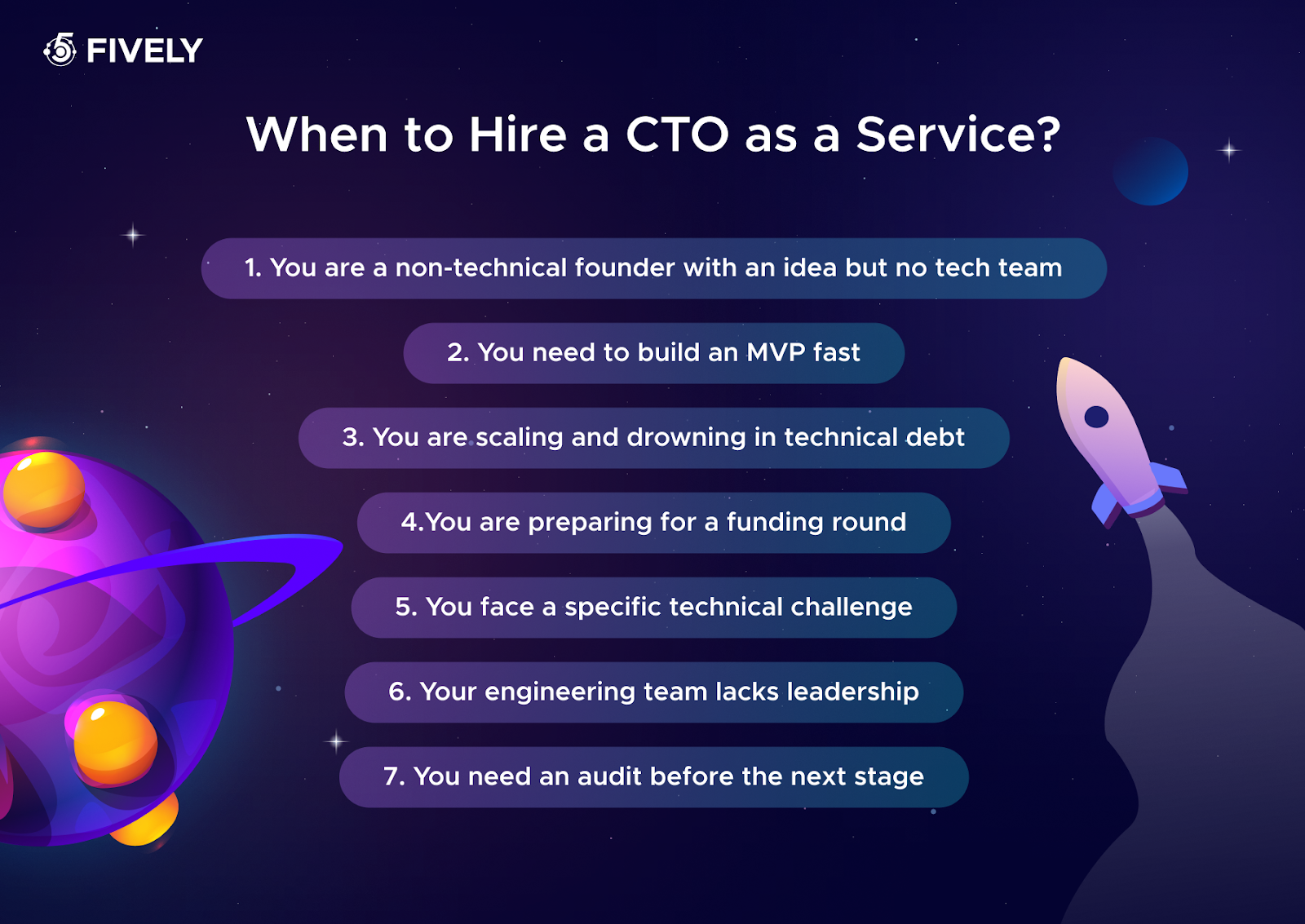
Not every startup needs CTO service from day one, but there are inflection points where the absence of technology leadership becomes a liability. Here are seven scenarios where CTOaaS delivers outsized value:
1. You are a non-technical founder with an idea but no tech team. You know the market problem, but you cannot evaluate developers, choose a tech stack, or define technical requirements. A CTO bridges that gap — formulating specifications, selecting technologies, and hiring the first engineers.
2. You need to build an MVP fast. Speed to market is critical, and without experienced technical leadership the risk of over-engineering (or under-engineering) the first product is high. A CTOaaS ensures the MVP includes exactly the features needed to validate market demand, nothing more and nothing less, and gets it shipped on a compressed timeline.
3. You are scaling and drowning in technical debt. The MVP worked, users are growing, but the codebase is buckling. A CTO conducts a thorough technical audit, identifies the highest-impact areas of debt, and develops a phased refactoring plan that balances stability with continued feature delivery.
4. You are preparing for a funding round. Investors expect to see a credible technology leader. A CTO strengthens the pitch by articulating the technical roadmap, demonstrating scalable architecture, and answering due-diligence questions with authority. Startups with visible technology leadership close rounds faster and at stronger valuations.
5. You face a specific technical challenge. Whether it is integrating AI capabilities, migrating infrastructure to the cloud, implementing real-time data processing, or achieving compliance certification, a CTOaaS brings targeted expertise without the commitment of a permanent hire.
6. Your engineering team lacks leadership. You have developers, but no one is setting architectural direction, enforcing code quality standards, or running structured sprints. A CTO introduces best practices, mentors junior engineers, and establishes the processes that turn a group of developers into a high-performing team.
7. You need an audit before the next stage. Before raising a Series A, launching in a new market, or onboarding enterprise clients, a CTO reviews the existing product for performance bottlenecks, security vulnerabilities, scalability limitations, and compliance gaps — giving you a clear picture of what needs to be addressed.
How CTOaaS Accelerates MVP Development
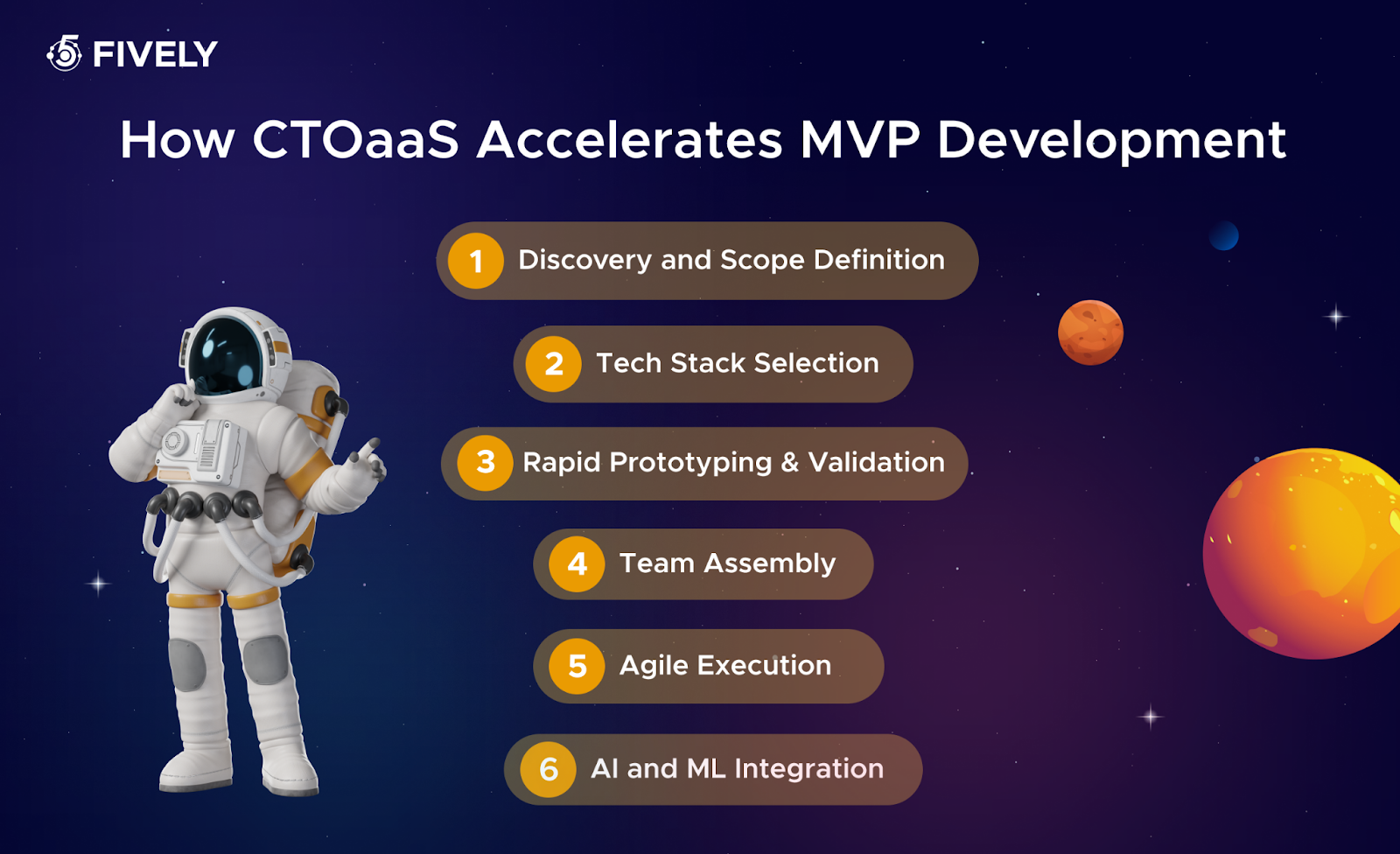
Building an MVP is where most startups either establish momentum or waste their runway. A CTO-as-a-Service engagement compresses the path from concept to launched product by bringing structure, experience, and pre-built execution capacity to each phase.
Discovery and Scope Definition. The CTO leads the discovery process — stakeholder interviews, competitive analysis, user research — to define the smallest set of features that proves market viability. The output is a prioritized product roadmap with clear milestones, realistic timelines, and a budget framework that keeps the founder in control.
Tech Stack Selection. The choice of technologies determines how fast you can build, how easily you can iterate, and how smoothly you can scale. A CTO balances these constraints based on the specific product requirements. An AI-powered platform might call for Python with TensorFlow or LangChain; a consumer-facing app optimized for speed to market might lean on React Native and Node.js. The goal is never to chase the latest trend but to select the stack that maximizes velocity today without creating migration headaches tomorrow.
Rapid Prototyping and Validation. Before a single line of production code is written, a CTO can initiate low-fidelity prototyping and user testing to validate core assumptions. This step catches flawed hypotheses early, when the cost of pivoting is measured in days rather than months.
Team Assembly. A CTOaaS provider like Fively already maintains a pool of senior engineers ready to begin work. Instead of spending weeks posting job listings and screening candidates, the CTO selects the right specialists from the existing bench and integrates them into the project within days.
Agile Execution. The CTO manages sprint cycles, conducts code reviews, monitors velocity, and ensures that quality gates — automated testing, security checks, performance benchmarks — are met before every release. The result is predictable delivery cadence and a product that ships clean.
AI and ML Integration. Artificial intelligence is no longer a feature reserved for late-stage startups with deep pockets. Fively has delivered AI solutions since 2018 — from natural language processing and predictive analytics to custom machine learning models. A CTOaaS engagement from Fively helps startups integrate intelligent features into their MVP without the trial-and-error cost of building AI competency from scratch.
The Hidden Costs of Not Having a CTOaaS
The decision to delay or skip technology leadership often looks like a cost saving on paper. In practice, it tends to be the most expensive choice a startup can make.
Technical Debt That Demands a Full Rewrite. Architecture decisions made without senior oversight frequently result in codebases that cannot support growth. Startups that outgrow a poorly designed MVP face rewrite costs starting at $50,000 and stretching into six figures depending on the cloud computing provider, team, artificial intelligence needs, etc., — plus the months of lost momentum while the new version catches up to where the old one left off.
Missed Market Windows. Chaotic development without a technical roadmap means missed deadlines, feature creep, and a product that reaches users after competitors have already captured mindshare. In fast-moving verticals like FinTech and HealthTech, a three-month delay can be the difference between market leadership and irrelevance.
Wrong Technology Choices. Selecting an unsuitable tech stack can bottleneck scaling, inflate cloud infrastructure costs, or lock the product into a framework with a shrinking talent pool. Correcting these choices mid-flight requires migration efforts that consume engineering bandwidth for months.
Security Breaches and Compliance Failures. Startups without a security-minded technology leader routinely ship products with unpatched vulnerabilities, inadequate encryption, and non-compliant data handling. A single data breach can cost hundreds of thousands of dollars in fines, legal fees, and reputational damage — not to mention the loss of customer trust that no amount of marketing can repair.
Failed Funding Rounds. Investors increasingly expect to see a credible CTO or equivalent technology leader in the founding team. Startups that present to VCs without one signal a gap in execution capability. The capital that could have funded the next twelve months of growth goes to a competitor who demonstrated stronger technical foundations.
 Services Account
CTO as a Service Pricing Models: How Much Should You Pay?
CTOaaS pricing varies based on engagement depth, CTO experience, project complexity, and regional labor markets. The three most common models are:
- Hourly Rates: $100–$300* per hour. Best suited for one-off consultations, part-time CTOs, technical audits, or architecture reviews. This model works when you need targeted expertise for a defined scope without an ongoing commitment.
- Project-Based Fees: $5,000–$50,000* per project. Appropriate for clearly scoped deliverables — building an MVP, executing a cloud migration, conducting a comprehensive security audit. The price reflects the project’s complexity, timeline, and team size.
- Monthly Retainers: $5,000–$15,000* per month. The most common model for ongoing strategic CTO support. A retainer guarantees a fixed number of hours of CTO consulting or a defined set of responsibilities each month, providing continuity without the cost of a full-time salary.
Several factors influence where within these ranges a specific engagement will land:
- CTO experience level: a CTO with 15 years and multiple successful exits commands higher rates than one with 8 years of experience.
- Project complexity: a straightforward web application costs less to oversee than a multi-service AI platform with real-time data processing.
- Urgency: compressed timelines that require the CTO to deprioritize other engagements carry a premium.
- Additional resources: if the engagement includes access to a development team (engineers, QA, DevOps), pricing reflects the broader team composition.
For context, here is how full-time CTO salaries compare across major markets:
*All costs in this article are approximate and taken form the open sources according to the salaries in each region.
A CTOaaS engagement frequently delivers 40–60% cost savings compared to a full-time hire at equivalent or greater depth of expertise — particularly when the outsourcing provider, like Fively, bundles strategic leadership with access to a senior engineering team.
How to Choose the Right CTOaaS Provider: A Step-by-Step Checklist
Not all technology strategy providers are equal. Use this checklist to evaluate potential partners before making a commitment:
- Industry-specific technical expertise. Does the provider have demonstrated experience in your domain — FinTech, HealthTech, eCommerce, Cybersecurity? A CTO who understands your industry’s regulatory landscape and technical patterns delivers value faster than a generalist learning on the job.
- AI and ML competencies. If your product involves artificial intelligence, verify that the provider has shipped real AI projects — not just listed the capability on a website. Fively has delivered AI solutions since 2018, including AI-powered platforms for clinical decision-making and intelligent automation systems.
- Senior engineering depth. The CTO’s effectiveness depends on the team behind them. A provider with a high percentage of senior engineers — Fively’s team is 85% senior — means the CTO can delegate complex implementation tasks with confidence and minimal oversight.
- Verified reviews and industry recognition. Check Clutch, GoodFirms, and TechBehemoths for detailed, verified client feedback. Fively holds Clutch Global Leader and Clutch Champion recognition and has been named a Top AI Consulting Company in Poland (2025) and received Best Custom Software Development from TechBehemoths.
- Flexible engagement models. Can the provider offer advisory-only consulting, an embedded CTO, or a full-cycle development team? Rigid one-size-fits-all models break down as startup needs evolve.
- Communication and soft skills. A CTO must translate complex technical concepts into language that non-technical founders, investors, and stakeholders can act on. Evaluate communication clarity during the initial discovery call.
- Execution resources beyond the CTO. The best CTOaaS providers back the CTO with project managers, developers, QA engineers, and DevOps specialists — enabling rapid team assembly when the strategy calls for it.
- Transparent pricing. The pricing model should be clear, predictable, and free of hidden fees. Ask for a detailed breakdown before signing.
- Cultural and timezone compatibility. Effective collaboration requires reasonable overlap in working hours, language fluency, and alignment on work culture. Fively operates from offices in Poland and Canada, serving clients across Europe, North America, and Australia.
Why Fively Is the CTOaaS Partner Startups Trust
Fively is not a staffing agency that places freelance CTOs. We are a product-focused software development company that pairs strategic technology leadership and innovation with the engineering capacity to execute.
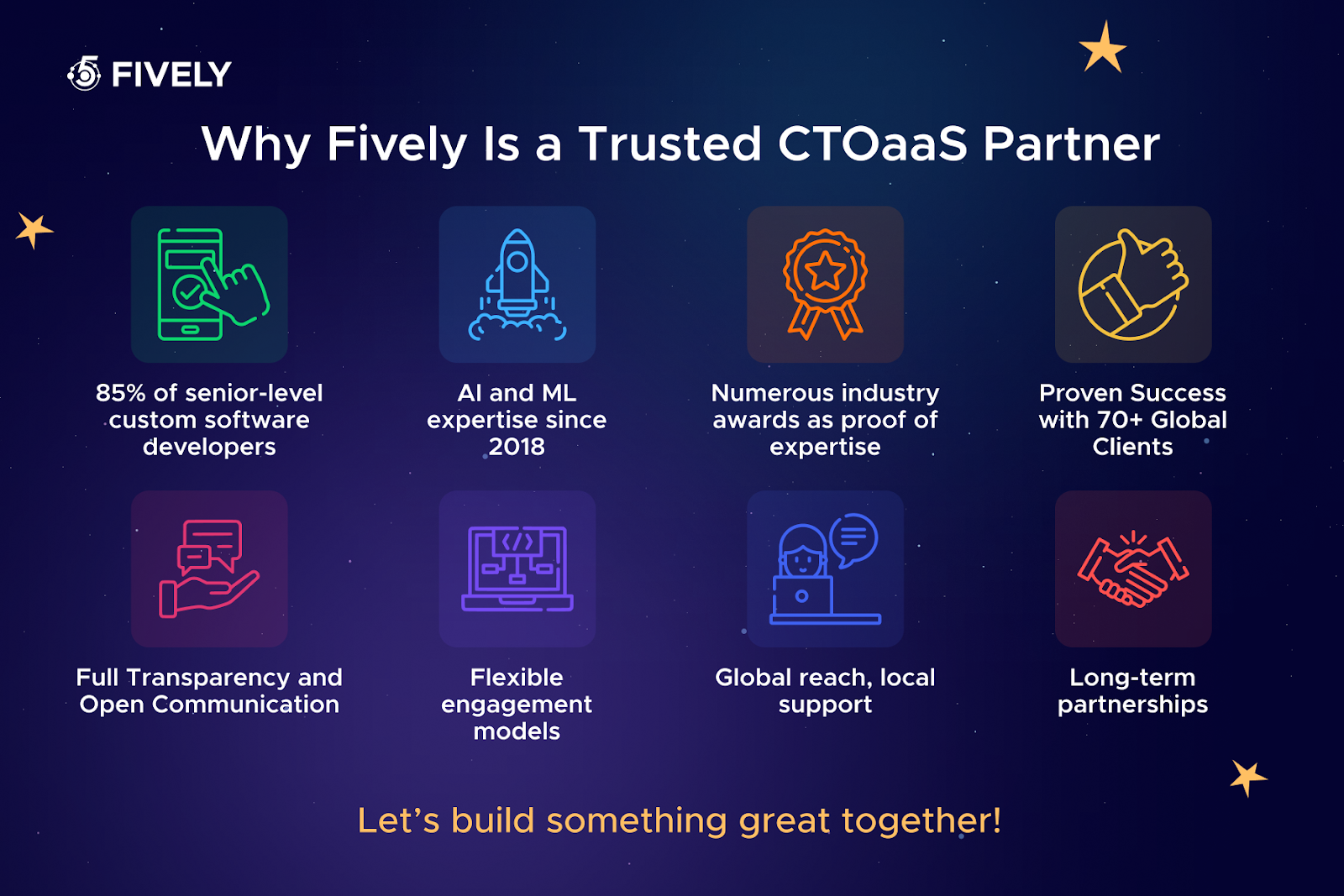
- 85% Senior Engineers. The vast majority of Fively’s 100+ developers are senior-level specialists with deep expertise across multiple domains and technology stacks. When a CTO defines a strategy, our team has the skill to implement it without hand-holding.
- AI and ML Expertise Since 2018. We have built and shipped AI-powered products — from AI-driven patient management platforms that support clinical decision-making through intelligent analytics to custom machine learning solutions for enterprise clients. Our CTOaaS engagements help startups integrate AI capabilities without the waste of building competency from scratch.
- 70+ Successful Projects. Our portfolio spans FinTech, HealthTech, Cybersecurity, eCommerce, Real Estate, and GreenTech — including Uniqkey (IAM automation trusted by thousands of European businesses), Insly (insurance digitalization across 60+ countries), and Cycle (e-bike rental platform operating in 85+ cities across Europe).
- Award-Winning Delivery. Clutch Global Leader (2023, 2024), Clutch Champion, Top AI Consulting Company in Poland (2025), and Best Custom Software Development from TechBehemoths (2025).
- Flexible Models — From Strategy to Full-Cycle Development. Whether you need a CTO for strategic guidance two days a week or a complete development team with a CTO at the helm, our engagement models adjust to match your stage, budget, and velocity requirements.
- Global Reach, Local Support. With offices in Poland and Canada and clients across Europe, North America, and Australia, Fively delivers CTO-level service with timezone-friendly communication and cultural alignment.
Conclusion
CTO as a Service is not a shortcut — it is a strategic choice. For startups that need technology leadership without the six-month recruiting cycle and the $300,000 salary commitment, CTOaaS delivers the expertise, the structure, and the risk mitigation that separate products that scale from products that stall.
The model works because it aligns the depth of a chief technology officer’s experience with the financial reality of building a company. You get architecture that holds under growth, a tech stack chosen for the right reasons, a development process that ships predictably, and a technology leader who can stand beside you in front of investors — all without the overhead of a permanent executive hire.
Fively brings something most CTOaaS providers cannot: a CTO backed by 100+ senior engineers, proven AI expertise dating back to 2018, and a portfolio of 70+ shipped products across FinTech, HealthTech, Cybersecurity, eCommerce, and beyond. Whether you need strategic guidance for a week or a CTO embedded with a full development team for a year, we build the engagement around your stage and your goals.
Ready to get the technology leadership your startup needs? Schedule a free consultation with Fively — we will help you determine which CTOaaS model fits your business and lay out a clear path from where you are today to where you want to be.
 Services Account
Need Help With A Project?
Drop us a line, let’s arrange a discussion
Frequently Asked Questions
A fractional CTO works part-time — typically two to three days per week — and may engage either remotely or on-site. The focus is split between strategic oversight and hands-on involvement in key decisions. A virtual CTO operates fully remotely and generally concentrates on high-level strategy, architecture guidance, and team mentorship without day-to-day presence in development workflows. Fively offers both models, and many engagements blend elements of each to match the startup’s needs.
Yes. A CTO participates directly in investor meetings, answers technical due-diligence questions, presents the architecture and scalability plan, and demonstrates the maturity of the engineering approach. Fively has supported clients through successful funding rounds by providing the technology credibility that investors look for before writing a check.
Most engagements begin within one to two weeks of signing the agreement. If a development team is also needed, Fively can assemble senior engineers from its existing bench and have them contributing to the project within the same timeframe.
CTOaaS is designed to be transitional when needed. The external CTO can assist with defining the full-time role, screening candidates, conducting technical interviews, and executing a structured knowledge transfer to ensure continuity. Fively has guided multiple clients through this transition without disruption to ongoing development.
Absolutely. Working with non-technical founders is one of our core specializations. We help translate business vision into technical requirements, select the appropriate tech stack, hire and manage the development team, and provide clear, jargon-free communication throughout the engagement. The goal is to give founders full confidence in their technology decisions without requiring them to become engineers.
Our technology consulting experience spans the verticals where startups are reshaping markets: FinTech, HealthTech, eCommerce, Cybersecurity, Real Estate, EdTech, GreenTech, and Media and Entertainment.


