
AI Agent Development Services

• 12 min
I'm a content specialist at Fively keen on writing fresh articles that can help out business and tech specialists. I love to conduct research, hold interviews, and spotlight sophisticated tech issues.
Fively provides custom AI agent development service from task-level automation to enterprise multi-agent systems. Explore our agentic AI development services, tech stack, and delivery process.
Automating individual tasks is useful. Automating entire workflows — where software reasons through decisions, pulls data from multiple systems, and acts without waiting for a human prompt — is where real operational leverage begins. Our custom AI agent development services deliver that leverage: production-grade agentic AI solutions built for security, scale, and measurable business impact.
Proven Track Record in AI and Agentic AI Development
Fively has been delivering AI-powered software since 2018, years before large language models became mainstream conversation. That depth of experience matters when the goal is not a demo, but a production system that handles real workloads.
Our AI agent development services have earned consistent recognition: Clutch Global Leader (2023, 2024), Clutch Champion, Top AI Consulting Company in Poland (2025), and Best Custom Software Development from TechBehemoths (2025).
The numbers behind the reputation also prove our expertise:
- AI delivery track record since 2018 — production ML systems shipped before the current LLM wave, across FinTech, HealthTech, Cybersecurity, Insurance, and eCommerce
- 85% senior-level engineering team — complex agent architectures demand experienced builders;
- 100+ developers available for rapid team assembly;
- End-to-end AI delivery from strategy through post-launch optimization;
- Full-cycle execution — strategy, architecture, development, deployment, and ongoing support from one accountable team with no handoff gaps
- Regulated-industry experience — PCI-DSS, HIPAA, GDPR, and SOC 2 requirements understood at the architecture level, not treated as afterthoughts
Services We Offer
Our agentic AI development services span the full project lifecycle. Each engagement is structured to match where your organization stands, whether you are exploring a first use case or scaling an existing agent ecosystem.
AI Agent Consulting
We start by mapping your operations, data infrastructure, and existing automation to identify where intelligent AI agents will generate the strongest return. The deliverable is a prioritized roadmap: which use cases to tackle first, what models and frameworks fit your constraints, how to structure the rollout, and what success looks like in measurable terms.
Custom AI Agent Development
Every agent we build is purpose-engineered around your business logic. We design the reasoning layer, connect it to your data sources, and construct the execution flow that lets the agent operate within defined boundaries. Whether the task is processing insurance documents or coordinating procurement approvals, the agent is shaped by your workflows — not forced into a generic template.
Multi-Agent System Design
When a single agent cannot cover the complexity, we architect multi-agent systems where specialized agents divide responsibilities and coordinate through structured protocols. Each agent owns a defined scope — data retrieval, decision logic, user interaction, compliance checks — while contributing to a unified outcome.
RAG-Powered AI Agents
Retrieval-augmented generation connects your artificial intelligence agents to internal knowledge — policy documents, product databases, support histories — so responses stay grounded in your actual data rather than relying on pre-training alone. We build the retrieval pipeline, manage vector indexing, and implement context strategies that minimize hallucination risk.
Agent Integration and Deployment
We embed agents into your operational infrastructure using secure API connectors, webhook integrations, and tested deployment patterns. Agents plug into CRMs, ERPs, helpdesk platforms, and legacy systems — deployed as standalone microservices or integrated into your existing architecture.
Ongoing Maintenance and Optimization
Launching an agent is the starting point, not the finish line. We monitor performance post-deployment, refine prompt strategies, update retrieval chains as your knowledge base evolves, and retrain models when accuracy drifts. The goal is an ai agent solution that improves continuously.
 Services Account
Types of AI Agents We Build
The right agent architecture depends on the task complexity, the required level of autonomy, and how deeply the system needs to interact with other software. Below is how we categorize the intelligent AI agents we deliver.
Not every problem requires a multi-agent system, and not every chatbot qualifies as an AI agent. We help you choose the agent architecture that matches the actual complexity of your use case — nothing over-engineered, nothing under-built.
AI Agent Development Process
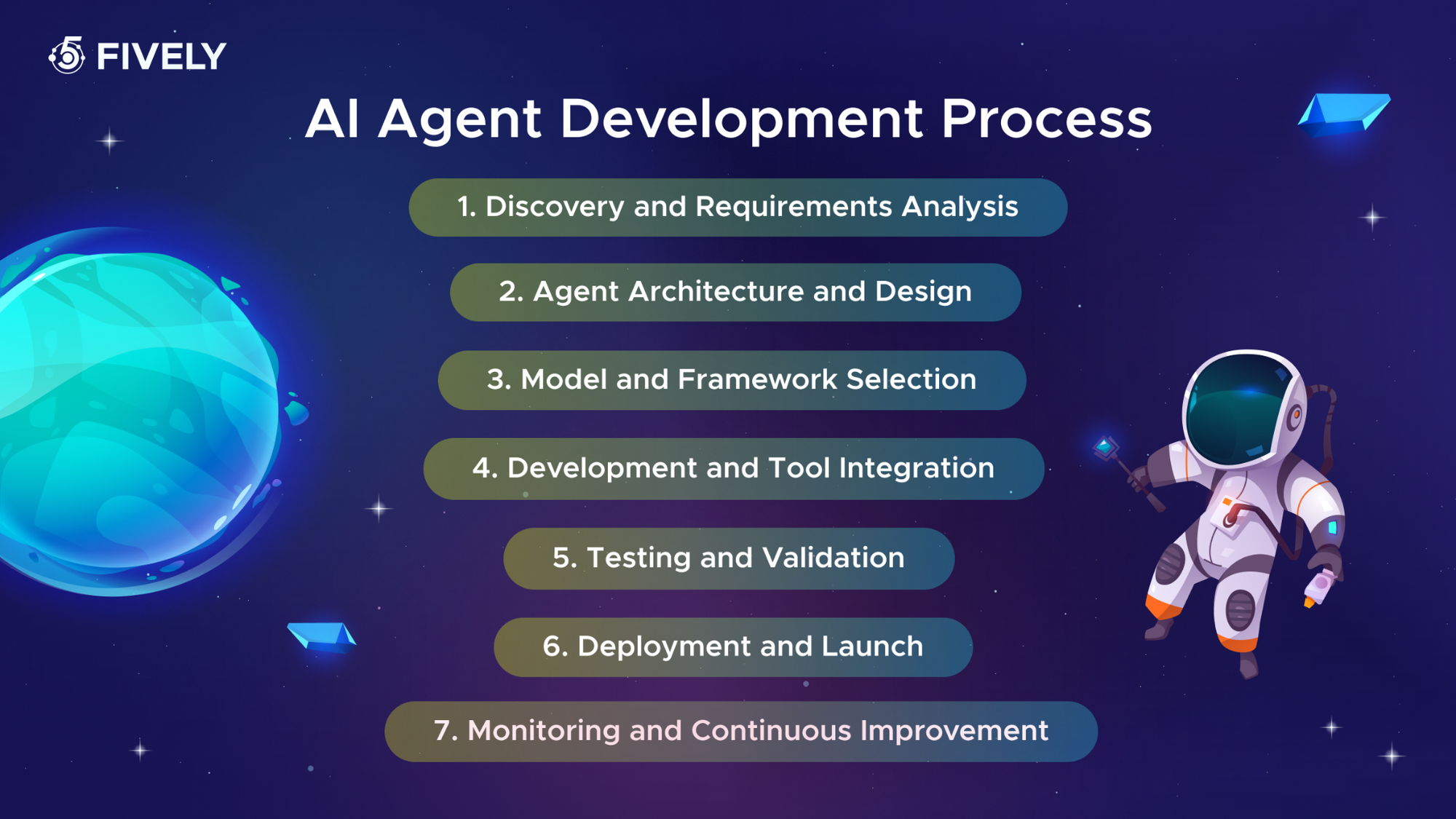
Each project follows a structured, seven-phase process designed to reduce risk and deliver working software on a predictable timeline.
1. Discovery and Requirements Analysis
We examine your current workflows, pinpoint automation candidates, and establish success metrics. This phase produces a feasibility assessment, a prioritized backlog of use cases, and a project timeline with clear milestones.
2. Agent Architecture and Design
We define the agent pattern — single, multi-agent, or hybrid — and design reasoning chains, memory strategies, tool-calling protocols, and fallback behaviors. All integration touchpoints with your existing systems are mapped at this stage.
3. Model and Framework Selection
Based on your requirements for accuracy, latency, privacy, and budget, we select the right combination of AI models and orchestration frameworks. Where standard models fall short, we scope fine-tuning or custom training workflows to close the gap.
4. Development and Tool Integration
Agents are built in modular increments, each component independently testable. We connect the agent to your APIs, databases, and third-party platforms with secure data flows and error handling baked in from the start.
5. Testing and Validation
We evaluate agent behavior against real-world scenarios through automated benchmarks and human review. Key metrics: task completion rate, response accuracy, latency, edge-case resilience, and bias indicators.
6. Deployment and Launch
Agents deploy to your environment of choice — cloud, on-premises, or hybrid — with monitoring dashboards, alerting rules, and rollback mechanisms active from day one.
7. Monitoring and Continuous Improvement
After launch, we track performance KPIs, collect user feedback, and run periodic evaluations. Prompt templates, retrieval configurations, and model parameters are tuned based on real usage patterns to keep the agent aligned with evolving business requirements.
AI Agent Solutions Across Industries
We build AI agents around specific industry challenges — not generic tools that require months of configuration to become useful.
- Finance and Banking. Agents that accelerate credit analysis, detect anomalous transactions, generate regulatory reports, and guide customers through account inquiries — built with the audit trail depth that financial compliance demands.
- Healthcare. Documentation agents that structure clinical data from physician notes, scheduling coordinators that cut administrative overhead, and patient-facing bots that route complex cases to clinical staff — all within HIPAA-compliant architectures.
- E-Commerce and Retail. Product recommendation agents that adapt to browsing behavior in real time, inventory bots that forecast demand and trigger replenishment, and customer service agents that resolve order issues without human escalation.
- Insurance. Claims intake agents that collect, validate, and route information automatically — Fively has built insurance claims automation that validates 80% of claims with no human involvement. Policy comparison and compliance monitoring agents complete the picture.
- Logistics and Supply Chain. Shipment tracking agents that proactively flag delays, route optimization bots that cut delivery costs, and demand forecasting agents that feed projections into procurement planning.
- Cybersecurity. Alert triage agents that classify threats in real time, vulnerability scanners that generate remediation plans, and incident response bots that execute containment protocols automatically. Fively has delivered anti-fraud solutions for telecom companies at enterprise scale.
Tech Stack
We choose technologies based on what the project requires — not to inflate a capabilities list. Here is the stack our artificial intelligence agent developers work with daily:
- LLMs and AI models: OpenAI GPT-5.4, Anthropic Claude, Codex, Meta Llama, Mistral, Google Gemini — selected for the right balance of accuracy, latency, cost, and data-privacy posture;
- Agent and orchestration frameworks: LangChain, LangGraph, CrewAI, AutoGen — for constructing reasoning flows, tool-calling logic, and multi-agent coordination layers;
- Vector databases and RAG: Pinecone, Qdrant, Weaviate, pgvector — the retrieval backbone that grounds agent responses in your enterprise knowledge;
- Backend and API layer: Python, FastAPI, Node.js — powering the core logic that ties agents to your systems;
- MLOps and infrastructure: Docker, Kubernetes, AWS (Bedrock, SageMaker), Azure (ML, OpenAI Service), MLflow, GitHub Actions — for model versioning, automated retraining, and continuous delivery;
- Data storage and integrations: PostgreSQL, MongoDB, Redis — alongside connectors for Salesforce, HubSpot, Zendesk, Jira, and custom enterprise APIs.
Governance and Compliance
Deploying AI agents into production environments demands more than functional accuracy. We embed governance controls into every phase of the AI agent development process:
- Regulatory alignment by design. Agent architectures are shaped around GDPR, HIPAA, CCPA, and industry-specific regulations from the earliest design decisions — compliance is structural, not a post-launch patch;
- Behavioral guardrails. We configure content filters, tool-use restrictions, and action-level permission boundaries that keep agents operating within their defined scope. No unauthorized escalations, no uncontrolled data access;
- Human-in-the-loop controls. For high-stakes decisions — financial approvals, clinical recommendations, compliance determinations — agents route outputs to human reviewers when confidence drops below defined thresholds;
- Full auditability. Every agent action, tool invocation, and reasoning step is logged with timestamps and context, creating audit trails suitable for regulatory review and incident investigation;
- Adversarial testing. Before deployment, we run red-teaming exercises and stress tests to expose failure modes, prompt injection vulnerabilities, and boundary-case behaviors — then harden the system against them.
 Services Account
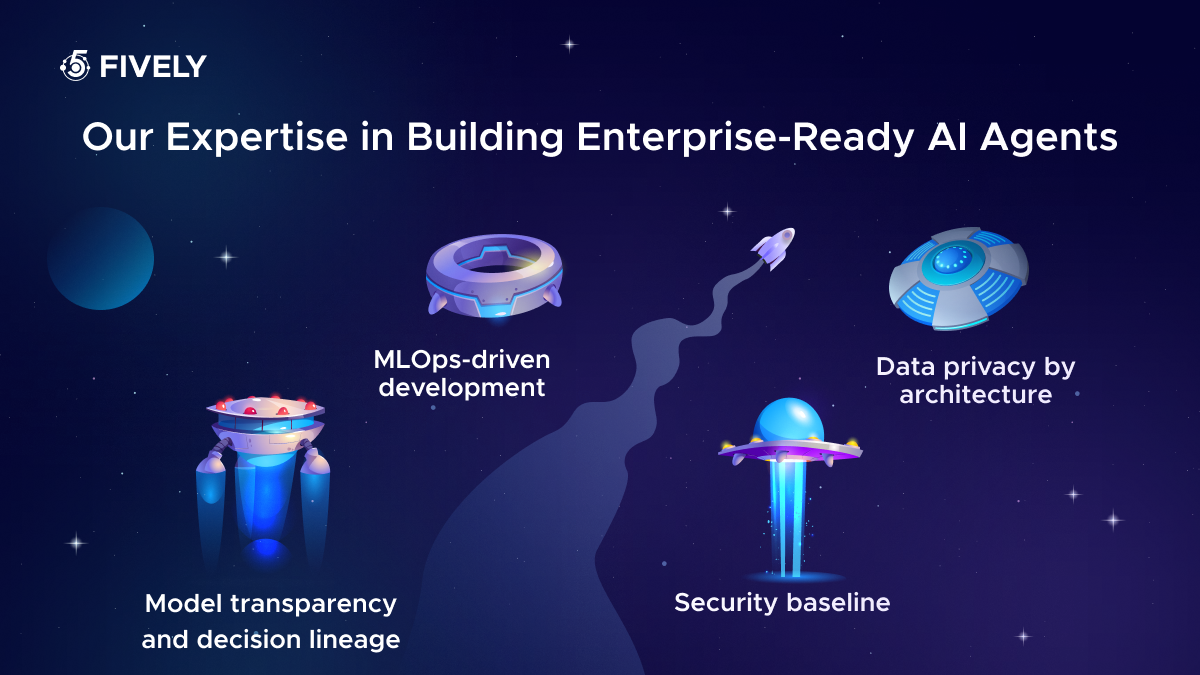
Our Expertise: Building Enterprise-Ready AI Agents
Enterprise adoption of agentic AI demands more than a prototype that works in a demo. It requires AI agent solutions that are auditable, explainable, and hardened for production workloads. Our approach to responsible AI development covers four pillars:
- Model transparency and decision lineage. Every decision an agent makes can be reconstructed and explained. We maintain a traceable chain from input data through reasoning steps to final output — a baseline for regulated industries and a trust factor for any enterprise.
- MLOps-driven development. Our engineers build versioned data pipelines, automated retraining workflows, and standardized preprocessing layers that keep agents accurate as your business data shifts — without manual intervention each time conditions change.
- Data privacy by architecture. For sensitive workloads, we deploy models within your infrastructure to eliminate data leakage. When external APIs are used, we enforce data minimization, PII redaction, and encrypted communication at every touchpoint.
- Security baseline. Data encryption at rest and in transit, role-based access control, API-level authentication, and continuous vulnerability scanning form the non-negotiable foundation of every deployment.
What Our Clients Say
Fively holds a 4.9 rating on Clutch based on verified client reviews.
Fively impresses with the excellent outcomes they achieve with service-minded attitude they maintain. — a Clutch Review by SpiritVen Founder David J Roman.
“We see them as partners who help us meet our goals rather than just contractors.” — a Clutch Review by VP of Engineering at Avi Medical GmbH, Bruno Monteiro.
"What impressed me the most are their work ethic and flexibility to adapt their services to our needs." — a Clutch Review by Founder & CTO of bloXmove.com, Harry Behrens.
Meet Our AI Engineering Team
Every AI agent project at Fively is backed by a cross-functional team of engineers, data scientists, and project managers with hands-on experience in machine learning, NLP, and enterprise system integration.
- Andrew Oreshko — A top-notch data scientist and ML engineer. Andrew boasts a rich background of AI-powered software projects. He thrives at the confluence of deep machine learning, NLP, LLMs, RNNs, and information retrieval, crafting solid machine learning pipelines for production. His passion extends to developing custom web products that push the limits of modern tech.
Andrew Oreshko: “AI agents are only as smart as the pipelines behind them — if your data flows are weak, your ‘intelligence’ is just expensive noise.”
- Maksim Zubov — A Senior Full-Stack engineer with over 11 years of experience. Maksim has contributed his knowledge to numerous well-known companies and startups in sectors like healthcare, insurance, banking, and finance. In his projects, Maksim actively adopts recent advancements in AI, ML, and deep learning, which highlights his depth of knowledge and adaptability in the field.
Maksim Zubov: “AI agents don’t replace engineers — they compress weeks of work into hours. The real skill is knowing what to trust and what to rewrite.”
- Tsimafei Tsykunou — A Senior AI & Data Engineer. Tsimafei has deep expertise in analytics-driven systems across diverse sectors such as cybersecurity, insurance, banking, and media. Backed by a strong academic foundation in applied statistics, he transforms AI-generated insights into reliable data pipelines and business-ready solutions using Python and SQL. His work ensures that fast-moving vibe coding products remain data-accurate, measurable, and decision-ready.
Tsimafei Tsykunou: “AI can generate answers instantly, but without proper data grounding, it just generates confidence — not truth.”
- Kiryl Anoshka — Solution Architect and Top-Level Cloud Specialist. Kiryl leads technical discovery and architecture planning for complex startup projects, translating business requirements into scalable system designs. With hands-on expertise in full-stack development, ML, and serverless platforms, Kiryl ensures that speed never compromises reliability or long-term value.
Kiryl Anoshka: “AI agents speed up development. You still need good architecture to point that speed in a useful direction.”
- Valentin Parshikov — Senior Full-stack and DevOps Engineer. With over 15 years of hands-on experience, Valentin specializes in building reliable, scalable systems that stand up to rapid iteration. His deep expertise in microservices and DevOps-ready architecture allows him to turn AI-assisted code into production-ready solutions with strong performance and stability. Valentin brings structure, resilience, and technical clarity to every project.
Valentin Parshikov: “AI can generate code in seconds, but making it reliable, scalable, and production-ready is still an engineering discipline.”
 Services Account
Need Help With A Project?
Drop us a line, let’s arrange a discussion
Frequently Asked Questions
Timelines scale with complexity. A focused proof-of-concept typically ships in four to six weeks. Production-grade agents with multiple system integrations require two to four months. Enterprise multi-agent systems with custom model training and compliance layers can take four to six months or longer, depending on data readiness and regulatory requirements.
A single task-specific agent starts in the low five-figure range. Workflow-level agents with several integrations and custom logic typically fall between $30,000 and $80,000. Multi-agent systems architected for enterprise-scale operations range from $80,000 to $200,000 or more, driven by scope, compliance demands, and ongoing support commitments.
Chatbots follow scripted conversation trees and respond within predefined boundaries. AI agents reason about goals, access external tools and live data, execute multi-step workflows across systems, and refine their performance through feedback loops. The distinction is autonomy: a chatbot answers questions, an AI agent solves problems.
Evaluate five dimensions: verified AI delivery experience with real case studies, security and compliance track record in your industry, ability to integrate with your existing enterprise stack, flexibility in engagement models (from consulting to full-cycle development), and transparent pricing with clearly scoped deliverables. A partner who has shipped production agents — not just built demos — will save months of iteration.
A single-agent system handles one defined function — processing invoices, answering support queries, or scoring leads. A multi-agent system deploys several specialized agents that collaborate on a shared objective, dividing tasks, exchanging context, and coordinating actions. Multi-agent architectures suit complex workflows where no single agent can manage the full decision chain alone.
Yes. We build integration layers using secure API gateways, custom middleware, and purpose-built connectors that allow agents to communicate with legacy CRMs, ERPs, and internal platforms. The approach preserves your existing infrastructure while giving agents controlled, auditable access to the data and actions they need.


