
A Guide to Every Startup Funding Stage: From Pre-Seed to IPO

• 23 min
I'm a content specialist at Fively keen on writing fresh articles that can help out business and tech specialists. I love to conduct research, hold interviews, and spotlight sophisticated tech issues.
This guide explains startup funding stages from pre-seed to IPO, helping founders understand how fundraising works and what investors may expect at each stage.
Raising capital is one of the most critical (and often most confusing) parts of building a startup. From early validation to rapid scaling, each startup funding stage plays a distinct role in shaping a company’s growth trajectory. Yet many founders enter the process without a clear understanding of what investors expect at each step.
In this guide, we break down the startup funding stages from pre-seed to late-stage rounds, explaining how they work, what they require, and how to navigate them with confidence. Whether you’re preparing to raise your first check or planning your next round, understanding the logic behind each stage can make all the difference.
Key Takeaways
- Startup funding is not a one-time event but a sequence of stages, each designed to support a different phase of growth — from validating an idea to scaling a proven business.
- Early stages like pre-seed and seed focus on product development and market fit, while later rounds (Series A, B, and beyond) are aimed at accelerating growth, expanding teams, and entering new markets.
- Each startup funding stage comes with higher expectations: stronger traction, clearer business models, and measurable performance metrics such as revenue, user growth, or retention.
- Valuation increases with each round, but so do investor demands — founders trade equity for capital, expertise, and strategic support.
- Understanding how each stage works helps CEOs make smarter decisions, raise funding more effectively, and avoid common pitfalls on the path to scaling a successful company.
Startup Funding Stages: Quick Comparison Table
Startup funding follows a fairly predictable progression, but the numbers and expectations change sharply from one stage to the next. The table below summarizes the main differences from pre-seed to IPO using the latest public 2025–2026 benchmarks where available; for later stages, figures are best treated as directional because public data is thinner and deal sizes vary more by sector and geography.
Pre-seed is the least standardized stage, because many companies raise on SAFEs or convertible notes instead of a priced round, so “valuation” is often expressed as a cap, not a true priced-equity valuation.
Later-stage medians are also more volatile because there are fewer public benchmark observations and much bigger sector-specific outliers.
Understanding Startup Funding Stages: The Basics
What Is Startup Funding?
Startup company funding refers to the process of raising capital to build, operate, and scale a new business.
In most cases, this capital comes from external sources such as angel investors, venture capital firms, or financial institutions, rather than from the founders themselves.
Startups typically need external funding because early-stage businesses rarely generate enough revenue to sustain growth on their own. Capital is required to develop products, hire teams, acquire customers, and expand into new markets — all before the business becomes profitable.
There are two primary ways startups raise money: equity financing and debt financing. Equity financing involves selling a portion of the company in exchange for investment, meaning investors receive ownership stakes and a share in future success. Debt financing, on the other hand, involves borrowing money that must be repaid over time, usually with interest, without giving up ownership.
Startup funding is not a single event but a lifecycle, typically progressing through multiple stages — from pre-seed and seed to Series A, B, and beyond.Stage of startups aligns with a company’s level of maturity, risk, and growth, with increasing amounts of capital raised as the business proves its potential:
- Pre-seed: Validate the idea — founders focus on research, problem-solution fit, and early prototypes.
- Seed: Build the product — develop an MVP, test it with users, and find product-market fit.
- Series A: Prove the business model — demonstrate traction, refine monetization, and show that the product can generate sustainable revenue.
- Series B: Scale operations — expand the team, grow the customer base, and optimize processes for rapid growth.
- Series C and beyond: Achieve market leadership — enter new markets, acquire competitors, and strengthen the company’s position globally.
- IPO (or exit): Enter public markets or achieve a strategic exit — providing liquidity for investors and enabling further масштабирование at a new level.
As startups progress, they raise larger amounts of capital while being expected to demonstrate stronger traction and clearer business outcomes.
Should You Raise Funding or Bootstrap?
Choosing between raising external funding and bootstrapping is one of the most important strategic decisions a founder will make. Each approach comes with trade-offs that impact control, growth speed, and long-term outcomes.
Venture Capital (VC Funding)
Bootstrapping
When VC funding makes sense: external funding is a strong fit for startups operating in large, competitive markets where speed is critical. If your product requires significant upfront investment (e.g., deep tech, AI, marketplaces) or you need to capture market share quickly, venture capital can provide the necessary fuel to scale before competitors do.
When bootstrapping is better: bootstrapping works well for businesses with lower upfront costs, clear monetization from the start, or niche markets where sustainable growth is more important than rapid expansion. It’s also a good choice for founders who prioritize independence and long-term profitability over aggressive scaling.
Many startups combine both strategies, starting with bootstrapping to validate the idea and gain early traction, then raising funding to accelerate growth once key metrics are proven. Others use selective funding (e.g., angel rounds or revenue-based financing) to maintain more control while still accessing capital.
To choose the right path, founders should evaluate key factors: market size, speed of competition, capital intensity, risk tolerance, and personal goals. If winning requires speed and scale, funding is often necessary. If the goal is building a profitable, controlled business, bootstrapping may be the better route.
How Equity Dilution Works Across Funding Rounds
Equity dilution is a natural part of raising external funding. It occurs when a startup issues new shares to investors, reducing the ownership percentage of existing shareholders — including founders.
At each funding round, investors provide capital in exchange for a stake in the company. This increases the total number of shares, which means each existing share represents a smaller percentage of ownership. While founders own less of the company after each round, the goal is that the company’s overall valuation grows, making their smaller percentage more valuable in absolute terms.
For example, a CEO who owns 100% of a startup at the beginning might own 70–80% after a seed round, 50–60% after Series A, and continue to dilute in later rounds. However, if the company’s valuation grows significantly, that reduced ownership can still translate into a much higher financial outcome.
Dilution doesn’t only affect founders — it also impacts early employees and previous investors. To manage this, startups often create an employee stock option pool (ESOP), which is also factored into dilution across funding rounds.
It’s important to understand that dilution is not inherently negative. In many cases, giving up equity is the price of accelerating growth, accessing expertise, and increasing the company’s chances of success. The key is to raise capital strategically — balancing ownership with the value that investors bring.
Ultimately, successful founders focus not just on how much of the company they own, but on how big the company becomes.
Pre-Seed Funding
What Is Pre-Seed Funding?
Pre-seed funding is the earliest stage of startup financing, typically used to turn an idea into a tangible concept.
At this point, founders are focused on validating the problem, exploring solutions, and building initial prototypes or MVPs. Many early-stage startups at this stage have little to no revenue and are still refining their vision, target audience, and product direction.
Pre-Seed Funding Amounts and Valuations
Pre-seed rounds are usually relatively small compared to later stages. Funding amounts commonly range from $50,000 to $500,000, though in some cases they can reach $1M+ depending on the market and team strength.
Valuations at this stage are often based more on the team and idea than on traction, typically ranging from $1M to $5M, but can be higher for experienced founders or high-potential markets (e.g., AI, fintech).
Who Invests in Pre-Seed Rounds?
Pre-seed funding usually comes from early believers willing to take higher risks:
- Founders themselves (bootstrapping)
- Friends and family
- Angel investors
- Early-stage venture funds (micro VCs)
- Startup accelerators and incubators
These investors are betting primarily on the founding team and the potential of the idea, rather than proven results.
What Investors Look For at Pre-Seed Stage
At the pre-seed stage, investors understand that uncertainty is high, so they focus on core fundamentals:
- Strong founding team: relevant experience, technical skills, and execution ability
- Clear problem-solution fit: a real, meaningful problem with a plausible solution
- Market potential: a large or growing market opportunity
- Early validation signals: prototypes, user feedback, waitlists, or initial traction
- Vision and clarity: the ability to articulate what the startup aims to build and why it matters
At this stage, investors are not expecting polished metrics: they are investing in people, potential, and direction.
Common Pre-Seed Mistakes to Avoid
At the pre-seed stage, small mistakes can have outsized consequences. With limited resources and high uncertainty, founders need to stay focused on what truly matters — validation, speed, and learning.
- Building too much, too early
Many founders overinvest in product development before validating the core idea. Instead of building a full-featured solution, focus on a simple MVP that tests key assumptions quickly.
- Ignoring real user feedback
Relying on assumptions rather than actual user input is a common pitfall. Early conversations, testing, and iteration are critical to ensure you’re solving a real problem.
- Targeting too broad a market
Trying to build for everyone often leads to weak positioning. It’s better to focus on a narrow, well-defined audience and expand later.
- Overvaluing the company
Setting an unrealistically high valuation at pre-seed can make future fundraising more difficult. It’s important to leave room for growth in later rounds.
- Choosing the wrong investors
Not all money is equal. Bringing in investors who lack relevant experience or alignment can create problems down the line. Strategic fit matters as much as capital.
- Lack of clear vision
Even at an early stage, founders need to clearly articulate what they’re building and why. A vague or constantly changing direction can undermine investor confidence.
- Underestimating execution speed
Pre-seed is about momentum. Moving too slowly can result in missed opportunities, especially in competitive markets.
Seed Funding
What Is Seed Funding?
Seed funding is the first significant round of external capital raised by a startup after the pre-seed stage.
At this point, the focus shifts from validating the idea to building a working product and achieving early product-market fit. Startups typically use seed funding to refine their MVP, grow an initial user base, and begin shaping a repeatable business model.
Seed Funding Amounts and Valuations
Seed rounds are larger than pre-seed and usually range from $500,000 to $3 million, though in competitive markets they can go higher. Valuations at this stage often fall between $5 million and $15 million, depending on traction, team strength, and market potential.
Who Invests in Seed Rounds?
- Seed funding is typically led by:
- Angel investors and syndicates
- Seed-stage venture capital funds
- Micro VCs
- Accelerators (follow-on investments)
At this stage, investors are still taking risks but expect to see early signs of traction and execution.
Seed Stage Metrics and Benchmarks
While startups are still early, some measurable signals are expected:
- Active users or early customer base
- User growth rate
- Engagement and retention metrics
- Initial revenue or monetization signals (if applicable)
- Customer feedback and validation
The exact benchmarks vary by industry, but the key is demonstrating that users find real value in the product.
What Investors Look For at Seed Stage
- Investors at the seed stage focus on:
- Product-market fit signals
- Execution capability of the founding team
- Clear use case and value proposition
- Scalability potential
- Early traction and momentum
At this stage, investors are looking for evidence that the startup is moving in the right direction.
How to Prepare for Seed Fundraising
To raise a successful seed round, founders should:
- Build a working product (MVP or beyond)
- Collect real user feedback and traction data
- Define a clear business model or path to monetization
- Prepare a strong pitch deck (problem, solution, market, traction, team)
- Identify and connect with relevant investors
Be ready to clearly explain how the funds will be used to reach the next milestone.
Series A Funding
What Is Series A Funding?
Series A funding is the stage where startups move from early traction and mentorship to building a scalable business.
The goal is no longer just validation, but proving that the business model works and can grow predictably.
Series A Funding Amounts and Valuations
Series A rounds typically range from $5 million to $20 million+, depending on the market and company performance. Valuations often fall between $20 million and $100 million+, with strong outliers in high-growth sectors.
Who Leads Series A Rounds?
Series A rounds are usually led by:
- Venture capital firms (institutional investors)
- Occasionally supported by existing seed investors
- The lead investor typically sets the terms, valuation, and structure of the round.
Series A Metrics and Benchmarks
At this stage, metrics become critical. Investors expect:
- Consistent revenue growth (often monthly or quarterly)
- Strong retention and engagement
- Clear unit economics (e.g., CAC vs LTV)
- Defined target market and customer segments
- Early signs of scalability
For SaaS startups, this often includes reaching $1M+ ARR (though this can vary).
What Investors Expect at Series A
Series A investors are looking for:
- Proven product-market fit
- Repeatable and scalable growth model
- Clear go-to-market strategy
- Strong founding and leadership team
- Vision for scaling into a large business
At this point, the question shifts from “Does this work?” to “Can this become a big company?”.
The "Series A Crunch": Why Many Startups Fail Here
The “Series A crunch” refers to the sharp drop-off between startups that successfully raise seed funding and those that make it to Series A. While many companies can secure early-stage capital based on vision and initial traction, far fewer are able to prove that their business is truly scalable.
The main reason is the shift in expectations. At seed stage, investors bet on potential. At Series A, they expect evidence. Startups that fail to demonstrate strong product-market fit, consistent growth, and a clear path to revenue often struggle to raise the next round.
Common reasons for failure include weak retention, unclear monetization, poor unit economics, or lack of focus. In many cases, startups grow too fast without a solid foundation — or build products that attract users but don’t solve a critical enough problem.
How to Prepare for Series A
Preparing for Series A requires more than just growth: it requires structured, predictable growth.
Founders should focus on:
- Achieving clear product-market fit
- Demonstrating consistent revenue or user growth
- Understanding and improving unit economics (CAC, LTV, payback period)
- Building a repeatable go-to-market strategy
- Strengthening the core team and leadership structure
Equally important is storytelling. Founders need to clearly explain how the business works, why it scales, and what milestones the Series A funding will unlock.
Series A Pitch: What Makes It Different
A Series A pitch is fundamentally different from a seed pitch. It’s less about vision and more about proof.
Instead of focusing primarily on the idea, founders must present:
- Traction and metrics (growth, revenue, retention)
- Business model clarity
- Unit economics
- Market opportunity backed by data
- A clear scaling plan
Investors expect data-driven narratives supported by real performance, not just projections. The pitch should answer a key question: Why is this startup ready to scale now?
Series A Mistakes to Avoid
Many startups fail at Series A not because of lack of effort, but because of avoidable mistakes:
- Raising too early: approaching investors without strong enough traction
- Focusing on vanity metrics instead of meaningful indicators like retention and revenue
- Ignoring unit economics: scaling without understanding profitability
- Overcomplicating the product instead of refining what already works
- Weak storytelling: failing to clearly communicate the business model and growth strategy
- Lack of focus: trying to do too many things instead of doubling down on core strengths.
Series B Funding
What Is Series B Funding?
Series B funding is the stage where startups transition from early traction to scaling a proven business model. By this point, the company has validated product-market fit and demonstrated consistent growth. The focus now shifts to expanding operations, growing market share, and building a strong, scalable organization.
Series B Funding Amounts and Valuations
Series B rounds are significantly larger than Series A, typically ranging from $20 million to $100 million+, depending on the market and growth rate. Valuations often fall between $100 million and $500 million+, with higher valuations common in high-growth sectors like AI, fintech, and SaaS.
Series B Metrics and Benchmarks
At Series B, performance metrics become more advanced and closely scrutinized:
- Strong and consistent revenue growth (often $5M–$20M+ ARR for SaaS)
- High retention and low churn rates
- Scalable unit economics (LTV > CAC)
- Efficient customer acquisition channels
- Clear expansion opportunities (new markets, segments, or products)
- Investors expect not just growth, but efficient and repeatable growth.
What Investors Look For at Series B
Series B investors are focused on scale and execution:
- Proven, repeatable business model
- Predictable revenue streams
- Strong operational performance
- Experienced leadership team
- Clear path to market leadership
At this stage, the question becomes: Can this company dominate its market?
Series B Strategy: Going from Growth to Scale
Series B is about turning growth into structured scale. Key strategic priorities include:
- Expanding sales and marketing teams
- Entering new geographic or vertical markets
- Investing in infrastructure and technology
- Strengthening internal processes and operations
- Building a scalable organizational structure
The goal is to accelerate growth while maintaining efficiency and control.
Series B Challenges and How to Overcome Them
- Scaling too fast without structure: rapid hiring and expansion can create operational chaos.
Solution: Invest in processes, leadership, and clear organizational design.
- Declining efficiency: customer acquisition costs can rise as the company scales.
Solution: Continuously optimize channels and improve unit economics.
- Maintaining product quality: as teams grow, product focus can weaken.
Solution: Keep strong product leadership and prioritize core value.
- Market competition intensifies: at this stage, competitors are more aggressive.
Solution: Differentiate clearly and double down on strengths.
- Leadership gaps: early-stage teams may lack experience in scaling companies.
Solution: Bring in experienced executives and advisors.
Series C Funding
What Is Series C Funding?
Series C funding is a late-stage round focused on accelerating expansion and strengthening market leadership.
By this stage, the company is already well-established, with a proven business model, strong revenue streams, and a clear position in the market. The goal is no longer to validate or optimize, but to scale aggressively and prepare for a potential exit, such as an IPO or major acquisition.
Series C Funding Amounts and Valuations
Series C rounds are typically large, ranging from $50 million to $200 million+, and can go significantly higher for high-growth companies. Valuations often exceed $500 million and can reach into the multi-billion-dollar range, especially in sectors like AI, fintech, and enterprise SaaS.
Who Invests in Series C?
At this stage, the investor landscape expands beyond traditional venture capital:
- Late-stage venture capital firms
- Private equity firms
- Hedge funds
- Investment banks and institutional investors
- Corporate investors and strategic partners
These investors are generally more risk-averse and focus on companies with strong, predictable performance.
Series C Metrics and Benchmarks
Series C companies are expected to demonstrate mature, stable metrics:
- High and predictable revenue (often $50M+ ARR for SaaS)
- Strong profitability or a clear path to profitability
- Low churn and high customer lifetime value
- Efficient growth with optimized unit economics
- Established brand and market presence
At this stage, financial discipline and scalability are key.
What Investors Expect at Series C
Investors at Series C are looking for:
- Market leadership or a clear path to it
- Sustainable and predictable growth
- Operational maturity and strong governance
- Scalable infrastructure and global potential
- Exit readiness (IPO or acquisition strategy)
The key question becomes: Is this company ready to become a dominant, long-term player — or go public?
Series C Use of Funds: Strategic Options
Series C funding is typically used for high-impact strategic initiatives:
- Expanding into new international markets
- Acquiring competitors or complementary businesses
- Investing in advanced technology and infrastructure
- Scaling sales, marketing, and partnerships globally
- Preparing for IPO (legal, financial, and operational readiness)
At this stage, capital is used not just for growth, but for strategic positioning and long-term dominance.
Later Stages of Startup Funding: Series D, E, F and Beyond
Why Companies Raise Series D+
While many successful startups aim to go public after Series C, not all are ready — or willing — to do so. Later-stage rounds such as Series D, E, and beyond are typically raised to extend growth, delay an exit, or strengthen market position.
Companies may pursue additional rounds to:
- Enter new global markets
- Fund large-scale acquisitions
- Continue hypergrowth without public market pressure
- Improve financial metrics before IPO
- Navigate unfavorable market conditions (e.g., delaying a public listing)
These rounds provide flexibility, allowing companies to scale further while remaining private.
Series D, E, F: What’s Different?
At these later stages, startups are no longer early or mid-stage: they are mature, late-stage companies with established operations.
Key differences include:
- Larger funding amounts: often hundreds of millions per round
- Lower risk profile: companies have proven models and strong revenue
- More sophisticated investors: including private equity, hedge funds, and institutional capital
- Focus on efficiency and profitability rather than just growth
- Advanced governance and reporting standards
Unlike earlier rounds, these stages are less about proving the business and more about optimizing and expanding it at scale.
The "Stay Private" Trend
In recent years, many companies have chosen to stay private longer instead of rushing to an IPO. This shift is driven by several factors:
- Abundant late-stage capital from private markets
- Greater flexibility without public market scrutiny
- Ability to refine operations before going public
- Avoiding market volatility and short-term pressure
As a result, startups are reaching multi-billion-dollar valuations while still private, sometimes delaying IPOs for years.
Mezzanine Financing and Bridge Rounds
What Is Mezzanine Financing?
Mezzanine financing is a hybrid form of funding that sits between equity and debt. It is typically used by late-stage startups that are approaching an exit (such as an IPO or acquisition) and need additional capital to scale operations, strengthen financials, or finalize strategic initiatives.
This type of financing often comes with features of both worlds: it may be structured as debt but include options to convert into equity (e.g., warrants or convertible instruments). Mezzanine financing is usually more expensive than traditional debt due to higher risk, but it allows companies to raise capital without immediate dilution.
Startups use mezzanine financing to bridge the final phase of growth, optimize performance metrics, and position themselves more favorably for public markets or acquisition.
Bridge Rounds: Closing the Gap
Bridge rounds are short-term funding rounds designed to “bridge the gap” between major financing stages — for example, between seed money and Series A, or Series B and Series C.
These rounds are typically raised when a company needs more time to reach key milestones required for the next round, such as improving traction, hitting revenue targets, or refining the product.
Bridge funding can come in different forms:
- Convertible notes or SAFEs
- Short-term equity rounds
- Follow-on investments from existing investors
While bridge rounds can provide necessary flexibility, they may also signal that a startup is not yet ready for the next stage. When used strategically, however, they allow companies to extend runway, strengthen metrics, and raise the next round on better terms.
IPO
What Is an IPO?
An Initial Public Offering (IPO) is the process by which a private company becomes publicly traded by offering its shares on a stock exchange.
This transition allows the company to raise capital from a broad base of public investors while providing liquidity to early investors, board of directors, and employees.
Going public marks a major milestone in a startup’s lifecycle. It signals maturity, strong financial performance, and the ability to operate under increased transparency and regulatory oversight. An IPO also enhances brand visibility and credibility, opening new opportunities for growth, partnerships, and talent acquisition.
IPO Requirements and Preparation
Preparing for an IPO is a complex, multi-year process that requires both financial and operational readiness. Key requirements typically include:
- Strong financial performance: consistent revenue growth and a clear path to profitability
- Robust corporate governance: experienced leadership, board structure, and internal controls
- Regulatory compliance: adherence to financial reporting standards and legal requirements
- Audited financial statements: usually covering several years of performance
- Scalable infrastructure: systems and processes capable of supporting public company operations
In addition to meeting formal requirements, companies must prepare strategically by:
- Hiring investment banks (underwriters) to structure and market the offering
- Conducting due diligence and audits
- Developing a compelling equity story for investors
- Running a roadshow to attract institutional investors
An IPO is not just a funding event — it’s a transformation. Companies must shift from startup agility to public-market discipline, balancing growth with accountability and long-term shareholder value.
Alternative Funding Options Beyond VC
While venture capital is one of the most well-known ways to fund a startup, it’s far from the only option. Many CEOs explore alternative funding sources to retain more control, reduce dilution, or better align with their business model and growth strategy.
Revenue-based financing (RBF)
This model allows startups to raise capital in exchange for a percentage of future revenue. Repayments scale with the company’s performance, making it a flexible option for businesses with predictable cash flow, especially SaaS and eCommerce.
Crowdfunding
Platforms like Kickstarter and Indiegogo enable startups to raise funds directly from the public. This approach not only provides capital but also helps validate demand and build an early customer base.
Grants and non-dilutive funding
Government programs and organizations offer grants that do not require equity or repayment. These are especially common in sectors like deep tech, healthcare, and sustainability.
Corporate partnerships
Large companies often invest in or partner with startups to access innovation. These partnerships can provide funding, distribution channels, and industry expertise.
Venture debt
Unlike equity financing, venture debt allows startups to borrow money while minimizing dilution. It is often used alongside equity rounds to extend runway without giving up additional ownership.
Bootstrapping and reinvestment
Some startups continue to grow using their own revenue, reinvesting profits back into the business. This approach maintains full ownership and encourages financial discipline.
Alternative funding options give CEOs more flexibility in how they build and scale their companies. The right choice depends on factors such as growth goals, cash flow stability, risk tolerance, and how much control founders want to retain.
Common Startup Fundraising Mistakes (And How to Avoid Them)
Fundraising is a complex process, and even strong startups can struggle if they make avoidable mistakes. Understanding these pitfalls early can significantly improve your chances of securing the right investment on the right terms.
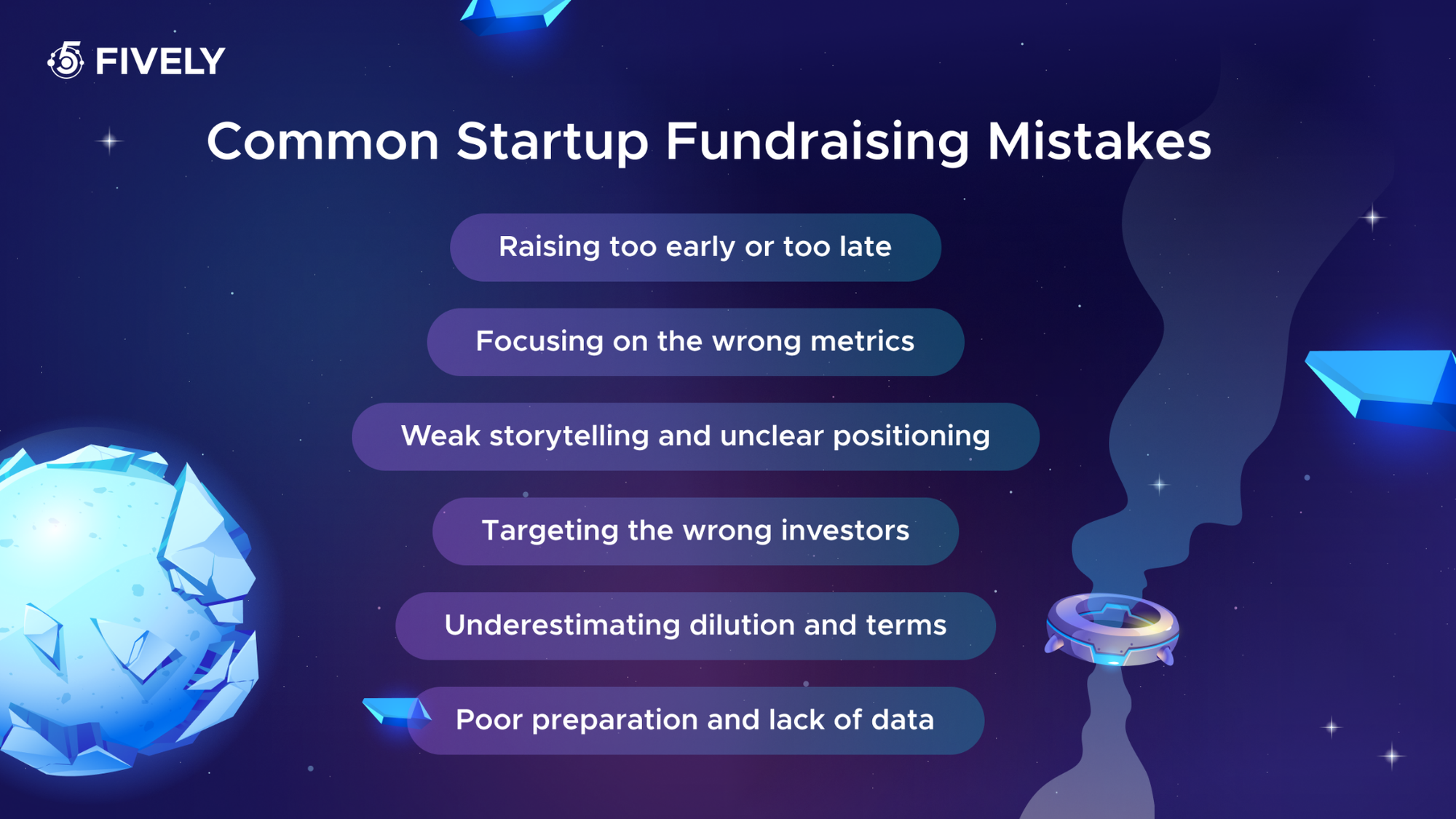
1. Raising too early or too late
Timing is critical. Raising too early can lead to poor terms and undervaluation, while raising too late can leave you with limited runway and weak negotiating power.
Solution: Start fundraising when you have clear milestones, early traction, and enough runway to negotiate confidently.
2. Focusing on the wrong metrics
Vanity metrics like downloads or sign-ups can be misleading if they don’t reflect real value. Investors care about retention, revenue, and growth quality.
Solution: Prioritize meaningful metrics such as engagement, churn, ARR, and unit economics.
3. Weak storytelling and unclear positioning
A great product is not enough if you can’t clearly explain it. Many founders fail to communicate their vision, market opportunity, or business model effectively.
Solution: Craft a clear, data-backed narrative that explains what you do, why it matters, and how it scales.
4. Targeting the wrong investors
Not all investors are a good fit. Approaching investors who don’t focus on your stage, industry, or geography wastes time and reduces your chances of success.
Solution: Research and target investors who align with your business and funding stage.
5. Underestimating dilution and terms
Focusing only on valuation while ignoring terms like liquidation preferences, board control, or vesting can lead to long-term issues.
Solution: Understand the full deal structure, not just the headline valuation.
6. Poor preparation and lack of data
Investors expect founders to know their numbers inside out. Weak preparation can quickly erode confidence.
Solution: Be ready with detailed metrics, financial projections, and clear answers to tough questions.
Fundraising Best Practices
Successful fundraising is not just about having a great idea — it’s about preparation, positioning, and execution:
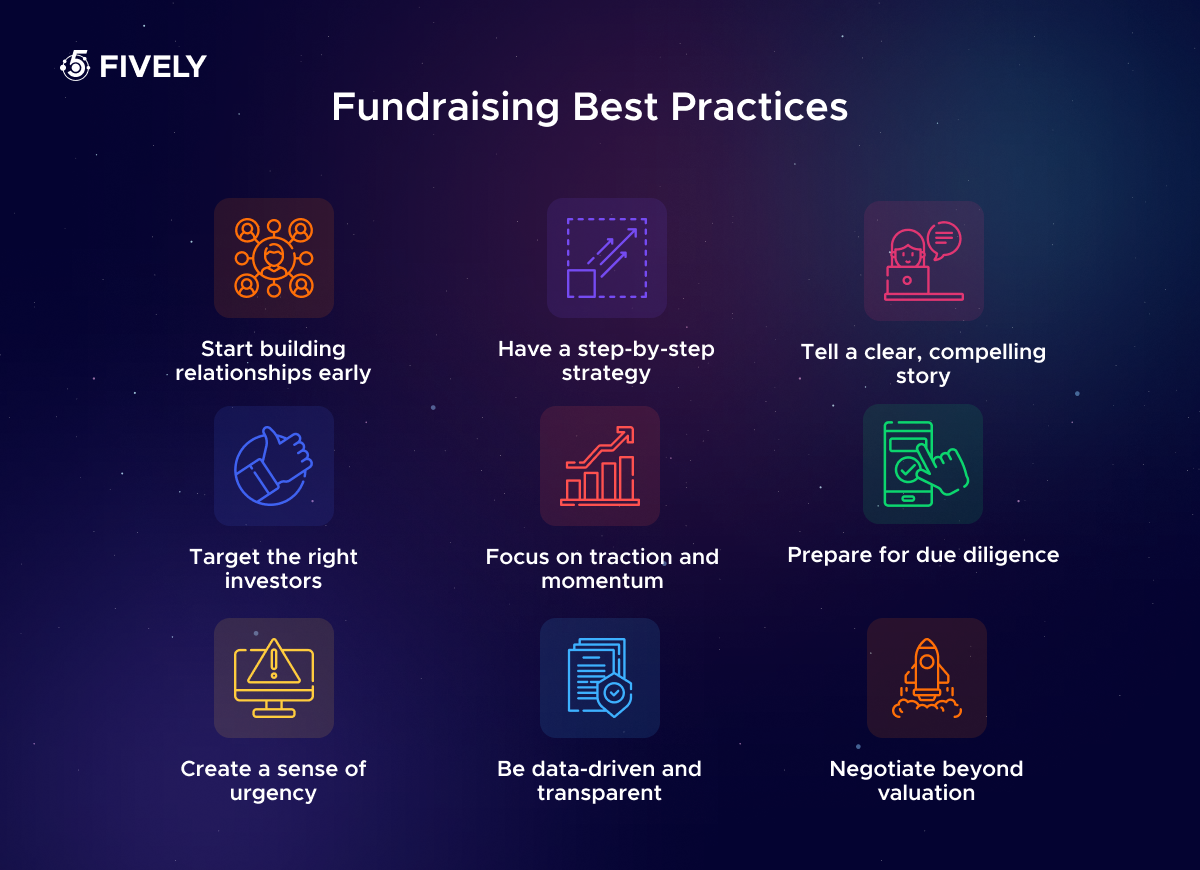
Have a step-by-step strategy
Founders who approach fundraising strategically significantly increase their chances of securing the right capital on favorable terms.
Start building relationships early
Fundraising begins long before you need money. Establish connections with potential investors months in advance by sharing updates, progress, and insights. Warm relationships convert much better than cold outreach.
Tell a clear, compelling story
Investors need to quickly understand what you do, why it matters, and how it scales. A strong narrative backed by data is far more effective than a complex or overly technical pitch.
Focus on traction and momentum
Demonstrating consistent growth — in users, revenue, or engagement — builds confidence. Momentum is one of the strongest signals for investors.
Target the right investors
Not all capital is equal. Focus on investors who specialize in your stage, industry, and geography, and who can bring strategic value beyond funding.
Be data-driven and transparent
Know your numbers: growth metrics, unit economics, and financial projections. Be honest about risks and challenges — transparency builds trust.
Create a sense of urgency
Fundraising works best when there is momentum and competition among investors. Structured timelines and clear milestones can help drive faster decisions.
Prepare for due diligence
Have all key materials ready: financials, legal documents, cap table, product demos, and metrics. Being organized speeds up the process and signals professionalism.
Negotiate beyond valuation
Valuation is important, but terms matter just as much. Pay attention to dilution, control, and investor rights to avoid future complications.
Frequently Asked Questions
There’s no fixed number. Most startups go through pre-seed, seed, Series A, B, and C before considering an IPO, but some raise additional rounds (D, E, etc.) or exit earlier via acquisition. The number of rounds depends on growth pace, capital needs, and market conditions.
Pre-seed funding focuses on validating the idea and building early prototypes, often with little to no traction. Seed funding is about building the product and gaining initial traction, with early users, feedback, and sometimes initial revenue.
On average, a funding round can take 2 to 6 months from initial outreach to closing. This includes pitching, negotiations, and due diligence. Timelines can vary depending on market conditions, startup readiness, and investor interest.
If a startup can’t secure funding, founders may need to extend the runway by cutting costs, increasing revenue, or exploring alternative funding options (e.g., bridge rounds, venture rounds). In some cases, startups pivot, get acquired, or shut down if no viable path forward exists.
A down round occurs when a startup raises funding at a lower valuation than its previous round. This can negatively impact morale and investor confidence. To avoid it, focus on strong traction, realistic valuations, efficient growth, and proper timing when raising your next round.
Yes, but it’s uncommon. Some startups with exceptional traction or strong founding teams may skip stages or raise larger rounds earlier. However, investors still expect the same level of maturity and metrics associated with each stage, regardless of naming.


