
Will the AI Bubble Burst? Inside the Hype, the Risk, and What Comes Next

• 17 min
I'm a content specialist at Fively keen on writing fresh articles that can help out business and tech specialists. I love to conduct research, hold interviews, and spotlight sophisticated tech issues.
Is the AI bubble about to burst? We break down how trillions in AI investment stack up against real revenue, what experts warn about, and what happens if it all crashes.
Nvidia crossed $5 trillion in market capitalization in late 2025, says Finance Yahoo*¹, making it larger than the GDP of every country on Earth except the United States and China. OpenAI, valued at $500 billion, committed to spending $1.4 trillion over eight years while pulling in roughly $13 billion in annual revenue*², stated CNBC. Microsoft poured almost $35 billion into AI infrastructure in a single quarter*³. These figures sound extraordinary because they are. The question everyone from Wall Street analysts to Reddit threads keeps circling back to is whether this is an AI bubble or a genuine technological revolution.
The tension between AI hype vs reality has never been sharper. On one side, generative artificial intelligence tools like ChatGPT have reached hundreds of millions of users, large language models are reshaping how companies build software, and leading AI companies such as OpenAI and Anthropic attract capital at a pace that dwarfs the early internet era. On the other side, an August 2025 report from the Massachusetts Institute of Technology Media Lab found that despite $30 to $40 billion in enterprise investment in generative AI, 95% of organizations saw zero return*⁴. That gap between spending and results is exactly the kind of signal that precedes an AI bubble crash.
Many people today are questioning whether the AI boom is turning into a bubble. In this article, we’ve brought together expert perspectives from publicly available sources to present a balanced view of the trends shaping the AI market. Our goal is to help you see the broader picture through multiple credible lenses.
Let’s examine where the term came from, what makes a financial bubble a bubble, how the current AI boom compares to past manias, what physical infrastructure underpins the hype, and where speculation may be outpacing fundamentals.
Please note that this article does not constitute financial advice or original market research. All insights and data referenced here are drawn from third-party studies and publications.
AI Bubble: Where the Term Came From
The phrase “AI bubble” describes a theorized stock market bubble that emerged during the broader AI boom, driven by concerns that leading technology firms are inflating valuations through massive and sometimes circular investments.
The term gained serious traction in financial media during 2024 and 2025 as AI-related stock prices soared far beyond traditional valuation metrics.
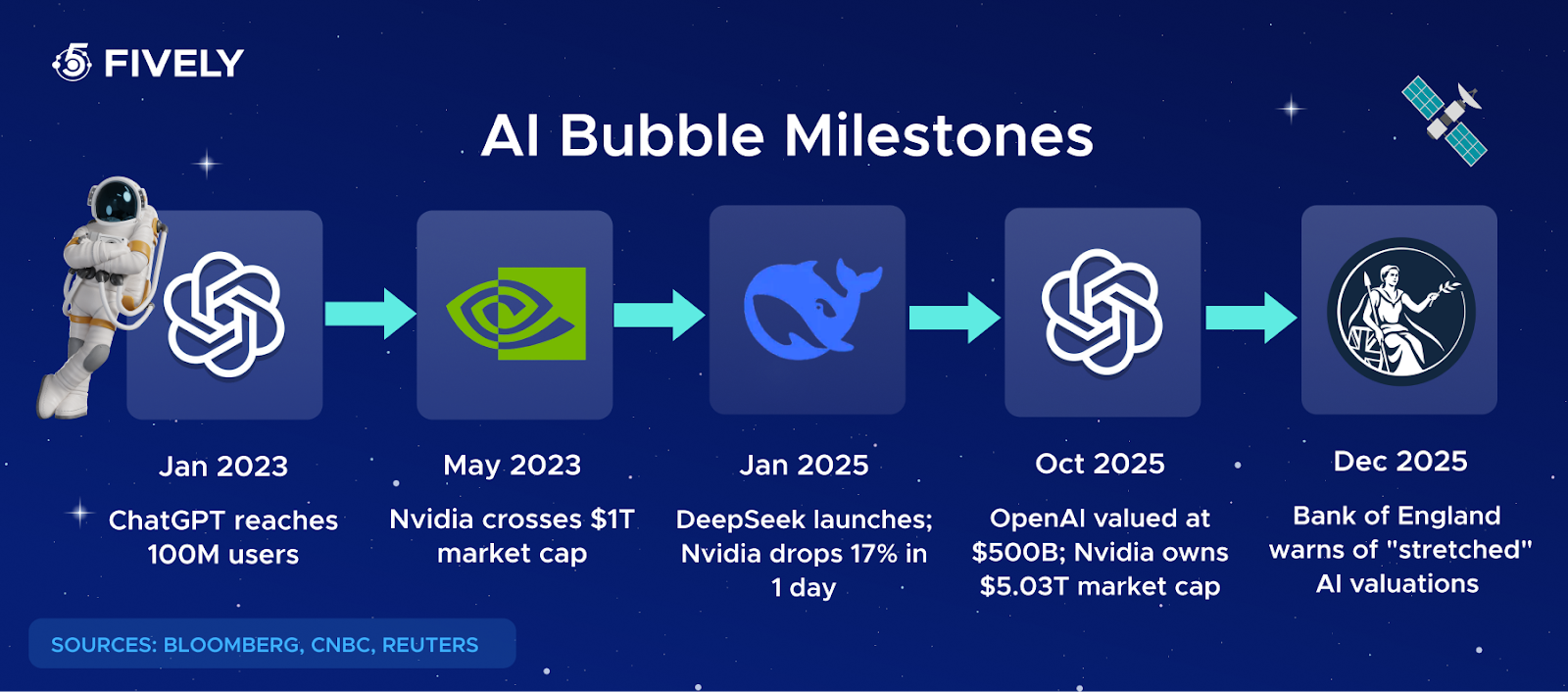
The timeline moves fast. Nvidia’s market capitalization quadrupled from $1 trillion in 2023 to over $4 trillion by mid-2025*⁵, powered almost entirely by demand for its AI training chips. Meanwhile, OpenAI’s valuation tripled from $157 billion in October 2024 to $500 billion by mid-2025*⁶, despite the company projecting annual operating losses through at least 2028.
The comparisons to the dot-com bubble started early, and prominent voices kept telling you the AI bubble is forming in plain sight. Ray Dalio, founder of Bridgewater Associates, said in early 2025 that current AI investment levels are “very similar” to the dot-com era. Sam Altman, chief executive officer of OpenAI, publicly acknowledged that an AI bubble is ongoing*⁷. Jamie Dimon, chief executive officer of JPMorgan Chase, warned in October 2025 that while AI is real, some money will inevitably be wasted, and he saw a higher chance of a meaningful stock drop over the following two years*⁸. Julien Garran of MacroStrategy Partnership went further, calling it “the biggest and most dangerous bubble the world has ever seen”, estimating it at 17 times the size of the dot-com bubble*⁹.
Not everyone agrees, and warning of an AI bubble does not mean agreement on what comes next. Goldman Sachs dismissed bubble concerns*¹⁰, attributing current valuations to fundamental strength and robust profit growth. Morgan Stanley called fears “misplaced” or “premature,” pointing out that the median cash flow and capital reserves of the top 500 US firms are approximately triple those during historical bubble periods*¹¹. Federal Reserve Chair Jerome Powell distinguished the current situation from the dot-com era, emphasizing that today’s AI leaders have substantially realized revenue and that capital expenditures are functioning as an engine of economic growth.*¹²
The debate, in other words, is far from settled.
What Makes a Bubble a Bubble
A financial bubble forms when asset prices rise significantly higher than their fundamental value. An asset can be anything people buy expecting it to hold or gain value: stocks, real estate, bonds, or even cryptocurrency.
The challenge is that fundamental value is not fixed or universally agreed upon. Two investors can look at the same company and reach different conclusions about what it is worth.
The mechanism is well understood. Bubbles start when investors buy because they believe something is undervalued. As prices climb, motivation shifts. People stop asking “What is this worth?” and start asking “How much higher can it go?”. That shift in psychology from value-driven investing to momentum-driven speculation is what separates a bull market from a bubble.
According to research from the Wharton School at the University of Pennsylvania, bubbles are not always invisible in real time. Many experts warned before both the dot-com boom and the housing collapse. The counterargument each time was the same: “This time is different because new technology is altering the fundamentals.”
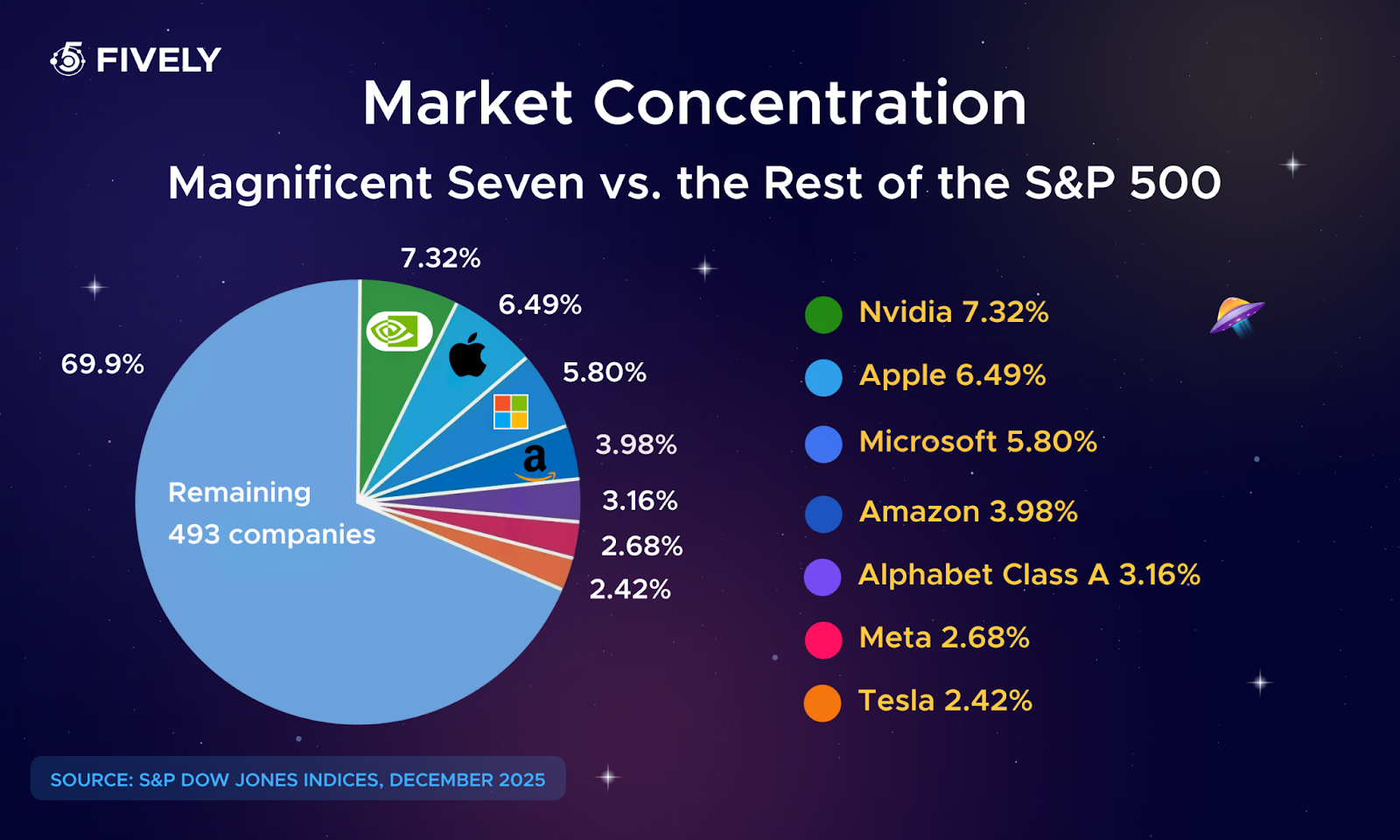
The current AI bubble is concentrated in what Wall Street calls the “Magnificent Seven”, the biggest technology companies that drive much of the S&P 500’s daily price moves. More households now own stocks through individual brokerages and retirement plans than in the late 1990s. Many funds are heavily weighted toward large technology companies. If their valuations fall, a lot of portfolios are going to take a hit, including those of people passively saving for retirement who may not even realize their exposure.
Michael Burry, the investor who predicted the 2008 housing collapse and was later portrayed in “The Big Short,” has turned his attention*¹³ to Big Tech’s multitrillion-dollar AI spending spree. His analysis, while not publicly detailed, points to the same risk pattern: enormous capital flowing into a sector where revenue has not yet caught up to investment.
There is also a less visible risk factor: private credit. A rapidly growing “shadow banking” system has emerged where non-bank institutions, including private credit funds and hedge funds, issue loans that play a similar role to traditional bank lending. These institutions are not regulated the same way and are often more opaque. When this type of lending grows very quickly, it can shift risk into corners of the financial system that regulators and the public cannot easily see. As one Wharton researcher*¹⁴ noted, “If something is growing very, very fast, it is probably also building up a lot of risks that we don’t fully understand”.
When will the AI bubble burst?
Predictions vary widely depending on who you ask and what layer of the AI economy they are analyzing. Some analysts point to late 2026, particularly for smaller companies that simply wrap existing AI APIs without building proprietary technology. Others see the broader correction unfolding between 2027 and 2030, as the gap between AI investment and AI revenue becomes harder to ignore. The honest answer is that identifying a bubble is one thing, but predicting when it will pop is another. As Wharton School finance professor Itay Goldstein*¹⁵ put it, “Most experts agree that something bubble-like is taking shape, but there’s more to it than that”.
What will happen when the AI bubble bursts?
If the AI bubble bursts, the impact will depend on how many people and institutions are tied to AI stocks and how much they have borrowed to finance those bets. For direct investors in AI companies, the losses could be severe. For the broader economy, the effects are harder to predict. Retirement portfolios with heavy exposure to Big Tech and the S&P 500 would take a hit. Mass layoffs at companies that over-invested in AI would follow.
On the positive side, hardware prices for GPUs and high-end electronics would drop as decommissioned data centers sell off equipment. Energy and electricity costs could decrease in regions where data centers consumed a significant share of the grid. The technology itself would not disappear. Useful AI applications would continue to develop, but the pace of speculative investment would slow dramatically.
 Services Account
Not All Bubbles Are Alike
History shows*¹⁶ that financial bubbles vary enormously in how much damage they inflict on the broader economy. The critical variable is not the size of the bubble itself but the degree of exposure: how many people, institutions, and banks are tied to the overvalued asset, and how much leverage they carry.
The dot-com bubble of the late 1990s was painful for investors but relatively contained for the general public. It was mostly private capital chasing internet startups. When it burst, households did not lose their homes, and the banking system remained intact. The infrastructure built during that era, particularly fiber optic cables, later enabled platforms like YouTube, Netflix, and cloud computing. The speculation was wasteful, but the underlying technology proved durable.
The housing bubble of the mid-2000s was a different story entirely. Toxic mortgage products, excessive leverage, and deep exposure across the banking system meant that when home prices fell, the consequences rippled through the entire world economy. Unemployment surged. Banks failed. The financial crisis of 2008 demonstrated what happens when a bubble intersects with systemic leverage.
Where does the AI bubble fit? The answer is uncomfortable: somewhere in between, with characteristics of both. Like the dot-com era, much of the value may ultimately survive in the form of real infrastructure and useful AI technologies. But unlike the dot-com era, the stock market concentration is far more extreme. Apple Inc., notably, avoided much of the damage*¹⁷ during recent sell-offs precisely because it did not invest as heavily in AI as its peers.
The Economist highlighted this market trend*¹⁸, observing that the bubble could inflict outsized damage precisely because passive investment vehicles have concentrated so much capital in so few names. By late 2025, the Magnificent Seven held 34.3 percent of the S&P 500 and roughly 20 percent of the MSCI World index, the highest concentration*¹⁹ in half a century. AI-related enterprises accounted for roughly 80 percent of gains in the American stock market in 2025, said the New York Times. A market correction in this sector would not be an isolated event. It would ripple through global retirement funds, sovereign wealth portfolios, and the balance sheets of banks holding AI-linked debt.
Some analysts estimate the current AI bubble at 17 times*²⁰ the size of the dot-com bubble. The Case-Shiller price-to-earnings ratio exceeded 40 for the first time since the dot-com crash, and the S&P 500 was trading at 23 times*²¹ forward earnings.
These are not panic numbers, but they are historically elevated, and the gap between AI investment and demonstrable AI revenue continues to widen. A correction in this space would not stay contained to Silicon Valley. It would reverberate across the global economy, hitting sovereign wealth funds, pension systems, and any startup company whose runway depends on continued access to venture capital.
AI Boom and Physical Infrastructure
One of the strongest arguments that the AI boom is more than hype is the sheer volume of physical infrastructure being built. Unlike the dot-com era, where many companies had little more than a website and a business plan, today’s leading AI players are pouring capital into tangible assets: data centers, power plants, semiconductor fabrication, and energy contracts.
According to a Goldman Sachs report, AI is expected to drive a 165% increase in data center power demand by 2030: global data center power consumption sat at roughly 55 gigawatts in 2023, and by 2030, that figure is projected to rise dramatically, with AI’s share of data center energy growing from 14 percent in 2023 to 27 percent by 2027. A single ChatGPT query consumes approximately 2.9 watt-hours, compared to 0.3 watt-hours for a standard Google search, a tenfold difference*²² that scales across billions of daily interactions.
The investment numbers are staggering. Roughly $1 trillion is projected*²³ to flow into AI data centers, semiconductors, grid upgrades, and related infrastructure. Microsoft alone spent almost $35 billion*²⁴ on AI infrastructure in Q3 2025. Amazon, Google, and Oracle Corporation are each deploying tens of billions more into cloud computing capacity designed specifically for AI workloads. Data center construction spending in the United States has tripled over the past three years, and an estimated $50 billion*²⁵ in utility investment will be needed for new power generation capacity through 2030.
The Three Layers of the AI Bubble
A VentureBeat analysis argues that framing this as a single AI bubble is misleading. Instead, there are three distinct layers, each with different economics, defensibility, and risk timelines.
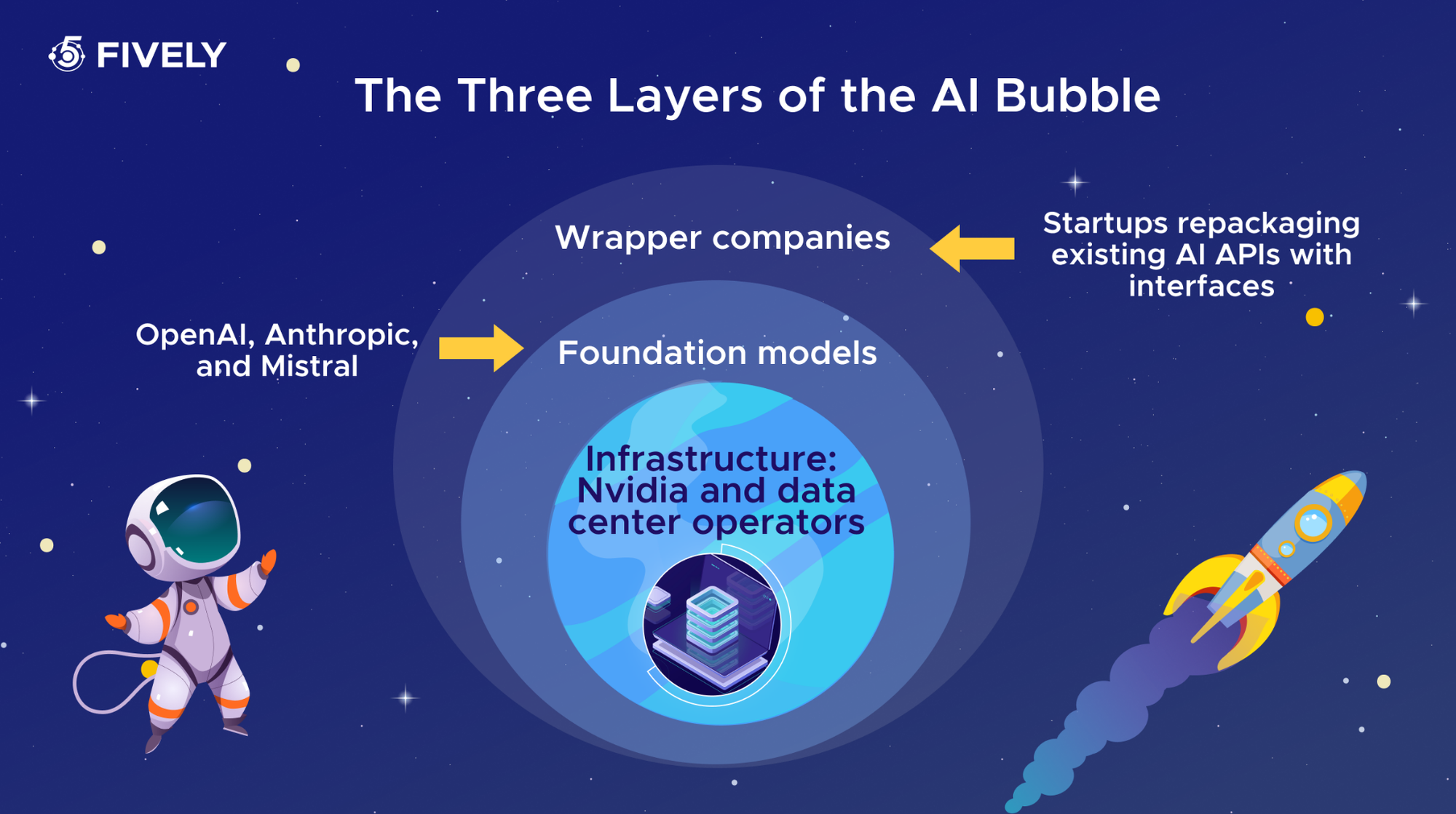
Layer 1: Infrastructure. This includes Nvidia, data center operators, cloud providers, and energy suppliers. This layer is the most durable because it retains value regardless of which AI applications ultimately succeed. Nvidia’s Q3 FY2025 revenue reached approximately $57 billion*²⁶, up 62 percent year-over-year, with its data center division alone generating $51.2 billion. Just as fiber optic cables built during the dot-com era later powered the streaming revolution, today’s AI infrastructure will serve future workloads that may not yet exist. Short-term overbuilding is possible, but long-term value retention is likely.
Layer 2: Foundation models. Companies building large language models (LLMs), including OpenAI, Anthropic, and Mistral, sit in the middle tier. Each invests billions, training the next frontier AI model, racing toward what some call AGI, or artificial general intelligence. The economics here are uncertain. Richard Bernstein pointed to OpenAI’s roughly $1 trillion in AI deals against just $13 billion in revenue*²⁷ as a pattern that “certainly looks bubbly” . The likely outcome is consolidation between 2026 and 2028, with two or three dominant players emerging and smaller providers being acquired or shut down.
Layer 3: Wrapper companies. These are startups that repackage existing AI APIs with interfaces and prompt engineering rather than building proprietary technology. This layer is the most vulnerable and expected to be the first to collapse. Large platforms like Microsoft, Google, and Salesforce can bundle wrapper functionality into existing products, eliminating the value proposition of standalone wrappers overnight. Significant failures in this space are expected by late 2025 to 2026. With over 1,300 AI startups valued above $100 million and 498 AI “unicorns” valued at $1 billion or more, many of these valuations will not survive*²⁸ contact with reality.
Understanding which layer you are investing in, building within, or depending on matters enormously. The cascade effect will likely move from Layer 3 downward: wrappers collapse first, foundation model companies consolidate next, and infrastructure normalizes last.
Speculation
The most striking feature of the current AI boom is the degree of circular investment flowing between its largest players. A Bloomberg analysis mapped the web of interconnected deals, creating what critics call artificial demand.
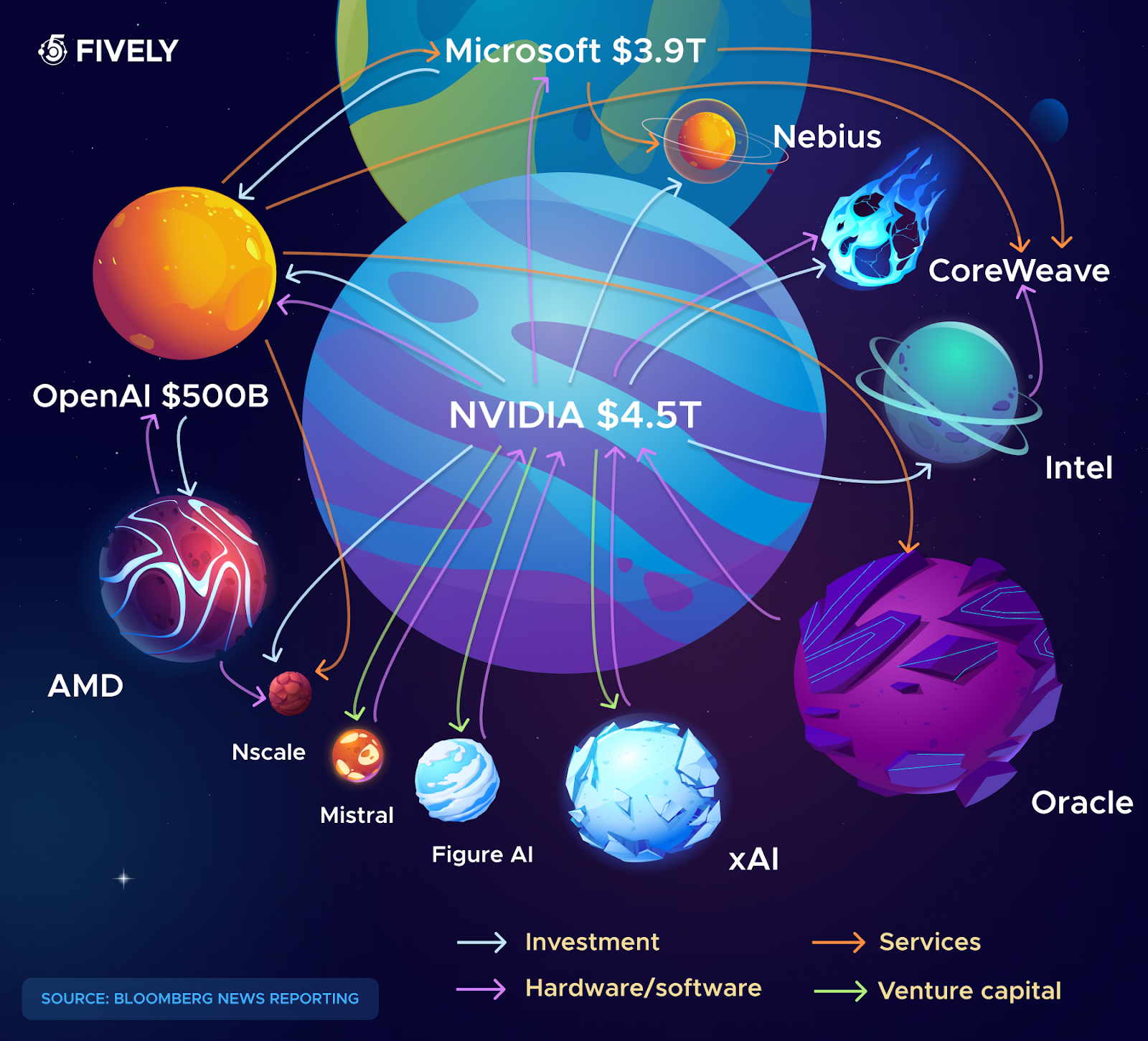
The diagram, with circles scaled by market value, shows Nvidia at the center, investing up to $100 billion in OpenAI. OpenAI then deploys 6 gigawatts of AMD GPUs, with AMD giving OpenAI the option to buy up to 160 million shares. OpenAI simultaneously signs a $300 billion cloud deal with Oracle. Oracle, in turn, spends tens of billions on Nvidia chips. Microsoft connects to nearly every node through hardware, investment, services, and venture capital relationships. The pattern extends to CoreWeave, Intel, xAI, Mistral, Figure AI, and other players, each linked by deals that feed capital back into the same ecosystem.
This circularity raises a critical question: how much of the reported demand for AI products and services reflects genuine end-user value, and how much reflects companies investing in each other? When Nvidia invests $100 billion in OpenA*²⁹, and OpenAI uses that money to buy chips that flow back to Nvidia’s revenue line, the resulting earnings growth can look organic from the outside while being largely self-referential.
Deutsche Bank analyst Jim Reid estimated*³⁰ OpenAI’s negative free cash flow at $143 billion between 2024 and 2029. Former Fidelity manager George Noble stated*³¹ that OpenAI is “burning $15 million per day on Sora alone”. OpenAI projected that it will not reach profitability before 2029*³² and may run out of money by mid-2027 without additional fundraising.
The broader stock market data reinforces this concern. The S&P 500 forward price-to-earnings ratio sits at 23 times, with the Case-Shiller ratio exceeding 40 for the first time*³³ since the dot-com crash. Share valuations across the AI industry have been described*³⁴ as “the most stretched since the dot-com bubble”.
Yet the counterarguments have weight. Today’s AI leaders have real revenue streams and durable margins, unlike the revenue-negative startups of the late 1990s. JPMorgan Chase applied a five-factor diagnostic framework*³⁵ and concluded that the AI sector does not yet meet classic bubble criteria. Whether these stronger fundamentals are enough to prevent a market correction or merely enough to cushion the fall remains the central question.
Is AI overhyped, and what real value justifies the investment?
The gap between AI hype and AI reality is narrower than skeptics suggest but wider than investors hope. Real value exists in code generation, enterprise automation, drug discovery, and logistics optimization. Companies deploying AI for specific, measurable tasks report meaningful efficiency gains.
The hype, however, lives in the assumption that every business needs AI, that every AI startup will generate returns, and that current spending levels are sustainable without proportional revenue growth.
The technology is real. The question is whether the investment is proportional to the value delivered.
Will open-source models disrupt the AI bubble?
Open-source AI models represent one of the most underappreciated risks to the current AI investment thesis. Chinese models, including those from ByteDance and others, have demonstrated performance comparable to leading commercial models at significantly lower cost.
If open-source models continue to close the gap with proprietary systems, the business case for paying premium prices to companies like OpenAI and Anthropic weakens considerably. This does not necessarily mean the AI bubble crashes overnight, but it threatens the revenue projections that justify current valuations, particularly at Layer 2 and Layer 3 of the bubble framework.
 Services Account
What’s the Next Hype After AI?
If history is any guide, the next hype wave won’t replace AI — it will build on top of it. We’re already seeing early signals in areas like autonomous agents, AI-powered robotics, spatial computing, and highly personalized digital experiences. The pattern is familiar: once a foundational technology matures and becomes widely accessible, the market shifts focus to applied layers that promise real-world transformation. In the near term, expect the spotlight to move from “AI that can generate” to “AI that can act” — systems that plan, execute, and integrate across complex workflows. That said, hype cycles are notoriously unpredictable. The winners won’t be the loudest new buzzwords, but the solutions that quietly solve expensive, persistent problems for businesses and users alike.
How Can You Separate AI Hype from Real Innovation?
The simplest filter is impact over impression. Real innovation delivers measurable value: reduced costs, faster workflows, higher conversion rates, or entirely new capabilities that were previously impractical.
Hype, on the other hand, tends to rely on vague promises, inflated benchmarks, and demos that don’t survive contact with production environments. Look for signals such as:
- clear ROI,
- repeatable use cases,
- transparent limitations,
- and evidence of long-term adoption beyond pilot projects.
Another strong indicator is integration depth: products that embed AI meaningfully into user workflows are far more likely to endure than those that merely add a chatbot on top. In a market saturated with bold claims, disciplined skepticism, backed by data, remains your best competitive advantage.
Wrapping Up
The AI bubble is not a signal to step back from the technology, but a reminder to engage with it more intelligently. Markets will always overpromise before they stabilize, but the underlying progress in AI is real and already reshaping how software is built and used. The companies that win in this phase won’t be the ones chasing headlines, instead, they’ll be the ones quietly shipping solutions that deliver consistent, measurable value.
For founders, product teams, and technology leaders, the strategy is clear: stay curious, stay pragmatic, and keep your standards high. Test boldly, measure rigorously, and prioritize real user outcomes over impressive demos. The hype will eventually cool — but the innovations that solve meaningful problems will remain, compound, and define the next generation of digital products.
 Services Account
Need Help With A Project?
Drop us a line, let’s arrange a discussion
List of the Sources Used in the Article
- https://finance.yahoo.com/news/nvidia-market-cap-crosses-5-133629703.html
- https://www.cnbc.com/2025/11/06/sam-altman-says-openai-will-top-20-billion-annual-revenue-this-year.html
- https://www.wired.com/story/data-center-ai-boom-us-economy-jobs/
- https://fortune.com/2025/08/18/mit-report-95-percent-generative-ai-pilots-at-companies-failing-cfo/
- https://www.cnbc.com/2025/07/09/nvidia-4-trillion.html
- https://horse.energy/HorseEnergy/openai_wework_analysis.html
- https://www.cnbc.com/2025/08/18/openai-sam-altman-warns-ai-market-is-in-a-bubble.html
- https://fortune.com/2025/10/08/jamie-dimon-head-in-the-sand-ai-will-take-jobs-tip-iceberg/
- https://www.cnn.com/2025/10/18/business/ai-bubble-analyst-nightcap
- https://www.goldmansachs.com/insights/articles/why-global-stocks-are-not-yet-in-a-bubble
- https://www.morganstanley.com/im/publication/insights/articles/43274.pdf
- https://www.facebook.com/joshrinconofficial/posts/breaking-fed-chair-jerome-powell-just-dropped-a-reality-check-on-the-ai-hypeits-/789948283803565/
- https://www.facebook.com/thefinancialexpress/posts/michael-burry-questions-soaring-ai-data-centre-spending-warning-of-leverage-risk/1360720486083540/
- https://knowledge.wharton.upenn.edu/article/unheeded-lessons-what-did-we-fail-to-learn-from-the-financial-crisis/
- https://penntoday.upenn.edu/news/there-ai-bubble-and-what-happens-if-it-bursts
- https://www.investopedia.com/articles/personal-finance/062315/five-largest-asset-bubbles-history.asp
- https://finance.yahoo.com/news/the-ai-trade-is-punishing-big-tech-but-not-apple-162049512.html
- https://www.economist.com/finance-and-economics/2026/01/14/is-passive-investment-inflating-a-stockmarket-bubble
- https://finance.yahoo.com/news/investors-worried-magnificent-seven-35-203500816.html
- https://www.marketwatch.com/story/the-ai-bubble-is-17-times-the-size-of-the-dot-com-frenzy-this-analyst-argues-046e7c5c?gaa_at=eafs&gaa_n=AWEtsqe7e-24ZHwZamVOo8srmxMKNZ9aSvOX0RrP06d7V0pMQX-DD-oGwyKuxHpUAck%3D&gaa_ts=699f4e29&gaa_sig=h4iFm9sVUoAHtSakgOMVVe3-Qh_Vtr0G7o7sMi3I2n_8-IMsGuHUIiG75xB-J8YLJrZhd1NlUm3iCgjwCPIzpA%3D%3D
- https://markets.businessinsider.com/news/stocks/stock-market-outlook-shiller-pe-ratio-dot-com-bubble-ai-2025-9
- https://www.marketwatch.com/story/ai-could-demand-a-shocking-amount-of-electricity-check-out-this-chart-e91e306d?utm_source=chatgpt.com
- https://www.brookings.edu/articles/the-future-of-data-centers/#:~:text=It%20is%20estimated%20that%20the,imperative%20to%20expand%20data%20centers
- https://finance.yahoo.com/news/microsofts-massive-ai-spending-draws-211443228.html
- goldmansachs.com/static-libs/pdf-redirect/prod/index.html?path=/pdfs/insights/pages/generational-growth-ai-data-centers-and-the-coming-us-power-surge/report.pdf&originalQuery=&referrer=https://www.google.com/
- https://investor.nvidia.com/news/press-release-details/2025/NVIDIA-Announces-Financial-Results-for-Third-Quarter-Fiscal-2026/default.aspx
- https://venturebeat.com/infrastructure/stop-calling-it-the-ai-bubble-its-actually-multiple-bubbles-each-with-a
- https://madhyamamonline.com/opinion/deep-read/the-ai-bubble-when-history-rhymes-with-the-doc-com-era-1468224
- https://www.wsj.com/tech/ai/the-100-billion-megadeal-between-openai-and-nvidia-is-on-ice-aa3025e3?gaa_at=eafs&gaa_n=AWEtsqdDF8vWtHmWI2cA6gzgMQhIXHKLpIixgD_VfQJIjxuhdcdKLc_GW_rhB0aHKYU%3D&gaa_ts=699f58b4&gaa_sig=6xf79PJtt1uYrC4uQV3V11lOa2THHD7csGDVHPdPQCZeYxEXgplsflmBDYrjS3lP79wTJyWv4ShnharVlsXL6w%3D%3D
- https://www.morningstar.com/news/marketwatch/20251205243/this-crazy-chart-shows-just-how-much-cash-openai-is-burning-as-it-chases-ai-profits
- https://economictimes.indiatimes.com/news/new-updates/openai-falling-apart-legendary-investor-george-noble-reveals-why-he-thinks-sam-altman-is-in-serious-trouble-and-has-an-advice-for-ai-startup-founders/articleshow/127099601.cms?from=mdr
- https://www.tomshardware.com/tech-industry/big-tech/openai-could-reportedly-run-out-of-cash-by-mid-2027-nyt-analyst-paints-grim-picture-after-examining-companys-finances
- https://www.forbes.com/sites/greatspeculations/2025/10/16/sp-500-poised-for-a-40-crash/
- https://www.independent.co.uk/news/uk/politics/bank-bank-of-england-andrew-bailey-financial-policy-committee-b2876195.html
- https://www.marketwatch.com/story/jpmorgan-gets-peppered-with-ai-questions-as-it-details-software-exposure-84d757ae?gaa_at=eafs&gaa_n=AWEtsqfVZsyWfkDb-NzbEz98W8O5zfVAuOZhgks7D8ExLpYb5LMu3d2tmu67ufReZ0o%3D&gaa_ts=699f5b5e&gaa_sig=1eJ40UW3ficNDq5JEw35yp41SGwt1-CTkwOegKlRVYAcz84_J2Vm0O3UGz5Hvc05vwte1mvriuN9ukjzLbmwtQ%3D%3D


