
A Guide to SaaS Pricing Models and Strategies

• 13 min
I'm a content specialist at Fively keen on writing fresh articles that can help out business and tech specialists. I love to conduct research, hold interviews, and spotlight sophisticated tech issues.
Explore our guide to SaaS pricing models and strategies — from usage-based to AI and hybrid pricing — and discover how to choose, implement, and optimize the right structure.
Pricing is more than a number on a pricing page — it’s a strategic growth lever that influences customer acquisition, retention, and long-term revenue. A well-designed SaaS pricing model aligns the value you deliver with what customers are willing to pay, helping you scale efficiently and compete more effectively.
In this guide, we explore the most common SaaS pricing models, the thinking behind them, and practical approaches for choosing, refining, and evolving a pricing strategy that supports your business goals.
What Is SaaS Pricing and How It Differs from Traditional Models
What sets SaaS products apart is not just how they are delivered, but how they are monetized. Unlike traditional software, which often relied on large upfront license fees and lengthy procurement cycles, SaaS solutions use subscription-based pricing that lowers the barrier to entry and allows customers to pay as they grow. This creates a more accessible buying experience while transforming one-time purchases into long-term customer relationships and predictable recurring revenue.
The subscription model also gives SaaS companies far greater flexibility:
- Pricing structures can evolve alongside the product, adapting to new features, customer needs, and changing market conditions;
- Businesses can create different plans for different customer segments, bundle or unbundle functionality, and experiment with usage-based pricing models that align costs more closely with the value customers receive.
This adaptability makes pricing a powerful tool for driving adoption, improving retention, and supporting sustainable growth.
Because revenue arrives continuously, monetization decisions compound over time. A small improvement to your pricing page or a smarter tier structure can lift profit margin across thousands of customers, which is why mature SaaS companies treat pricing as an ongoing discipline rather than a one-off launch task. Where traditional software locked value into a single sale, the SaaS revenue model rewards continuous optimization and tighter alignment between price and the value each customer receives.
 Services Account
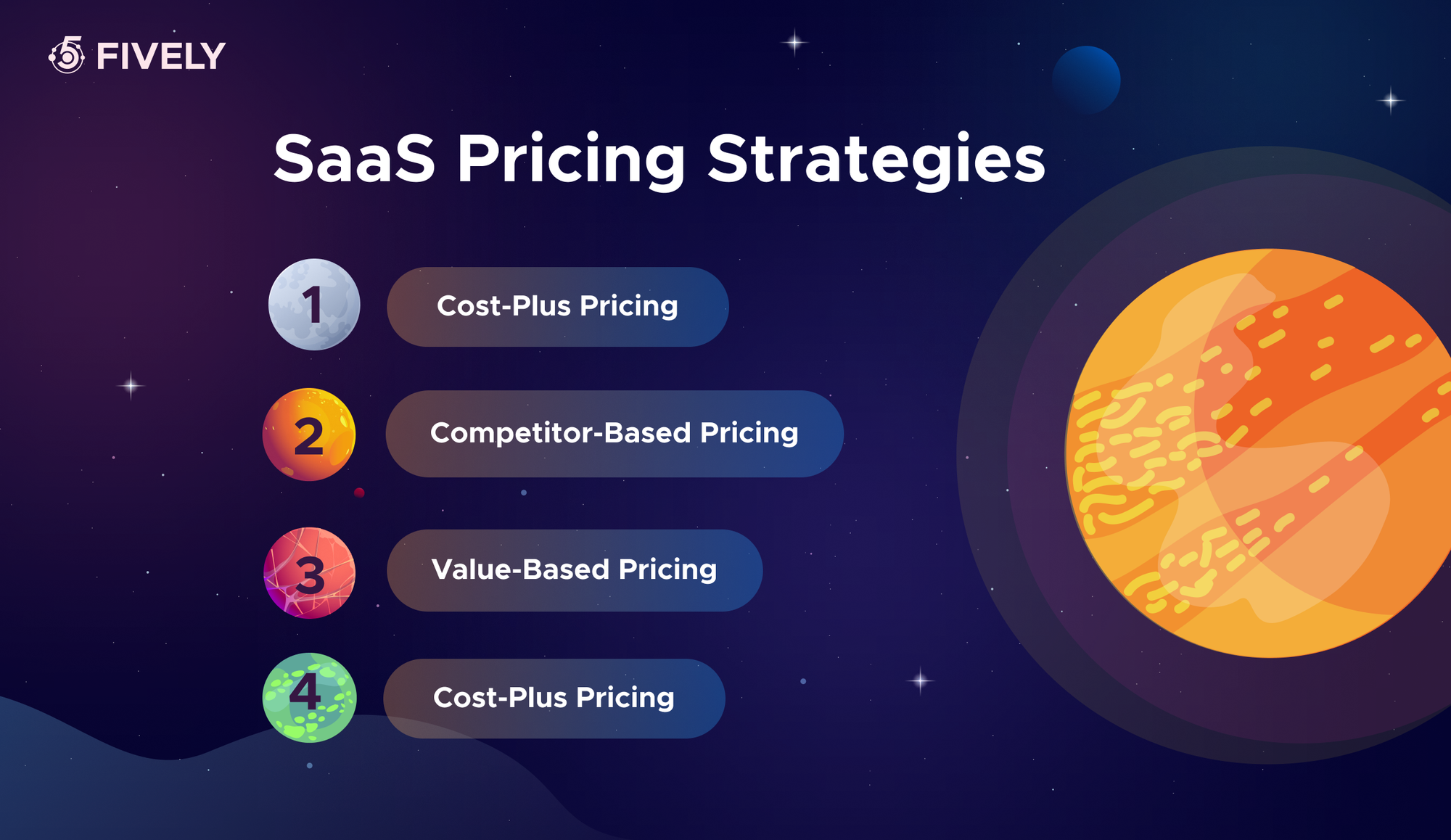
SaaS Pricing Strategies
Before choosing a model, you need a strategy—the logic that determines how you set the numbers. Most SaaS pricing strategies fall into a handful of approaches, and many companies blend them.
Cost-Plus Pricing
Cost-plus pricing is the simplest approach: calculate the cost to deliver your software, then add a target profit margin on top. For a SaaS business, that means tallying hosting, support, COGS, and development overhead, then layering a markup. It’s transparent and easy to defend internally, which is why early-stage teams gravitate toward it.
The downside is that it ignores what the product is actually worth to the customer, so it often leaves money on the table. Cost-plus pricing works best as a floor (a sanity check to ensure you’re not pricing below your unit economics) rather than as your primary method.
Competitor-Based Pricing
Competitor-based pricing anchors your price to what similar tools charge. You research competitor pricing across your category, then position yourself slightly below, at parity, or at a premium depending on your differentiation. This strategy reduces the risk of being wildly out of step with the market and gives prospects an easy reference point.
The danger is that you inherit your competitors’ mistakes and end up in a race to the bottom. Use it as one input (mapping the competitive landscape) rather than letting rivals dictate your entire revenue model.
Value-Based Pricing
Value-based pricing sets prices according to the outcomes and ROI customers receive, not your costs or competitors. If your software saves a customer 20 hours a week or generates measurable new revenue, you price as a fraction of that value.
This is the most profitable strategy for mature SaaS companies because it directly ties price to perceived worth and supports higher willingness to pay. It requires real research: interviews, surveys, and analytics to quantify value across different segments. Done well, value-based pricing aligns your growth with your customers’ success.
Penetration Pricing
Penetration pricing means launching at a deliberately low price to win market share quickly, then raising prices once you’ve built a base and proven value. It’s a popular strategy for new entrants fighting for attention in crowded markets and can drive fast adoption and network effects.
The risk is attracting price-sensitive customers who churn when rates rise, and conditioning the market to expect cheap software. Treat penetration pricing as a temporary investment in growth, paired with a clear plan to migrate to sustainable economics later.
Basic SaaS Pricing Models
A pricing strategy tells you how to set numbers; a pricing model defines the structure customers actually interact with. Here are the most common types of SaaS pricing models—with examples and where they tend to fit.
Most successful SaaS companies don’t pick a single model in isolation. Tiered pricing frequently combines feature-based gating with per-user seats, while infrastructure tools blend a flat-rate platform fee with usage-based overage. Freemium often serves as the top of the funnel for a tiered structure. The goal is a pricing structure that mirrors how customers derive value from your SaaS product.
B2B SaaS Pricing Models: From Mid-Market to Enterprise
B2B SaaS pricing models have to scale across very different buyers — from a five-person startup self-serving a credit card to a global enterprise negotiating a six-figure annual contract. The right approach shifts as you move up-market.
Models for Mid-Market Companies
For mid-market buyers, the optimal pricing models for SaaS are:
- tiered,
- per-user,
- usage-based,
- or a hybrid of subscription plus usage.
These customers expect a blend of self-service onboarding with a light sales touch, and they value pricing that scales predictably as they add people or volume. Per-user models make budgeting easy, while usage components ensure cost tracks actual activity.
Real-world examples include:
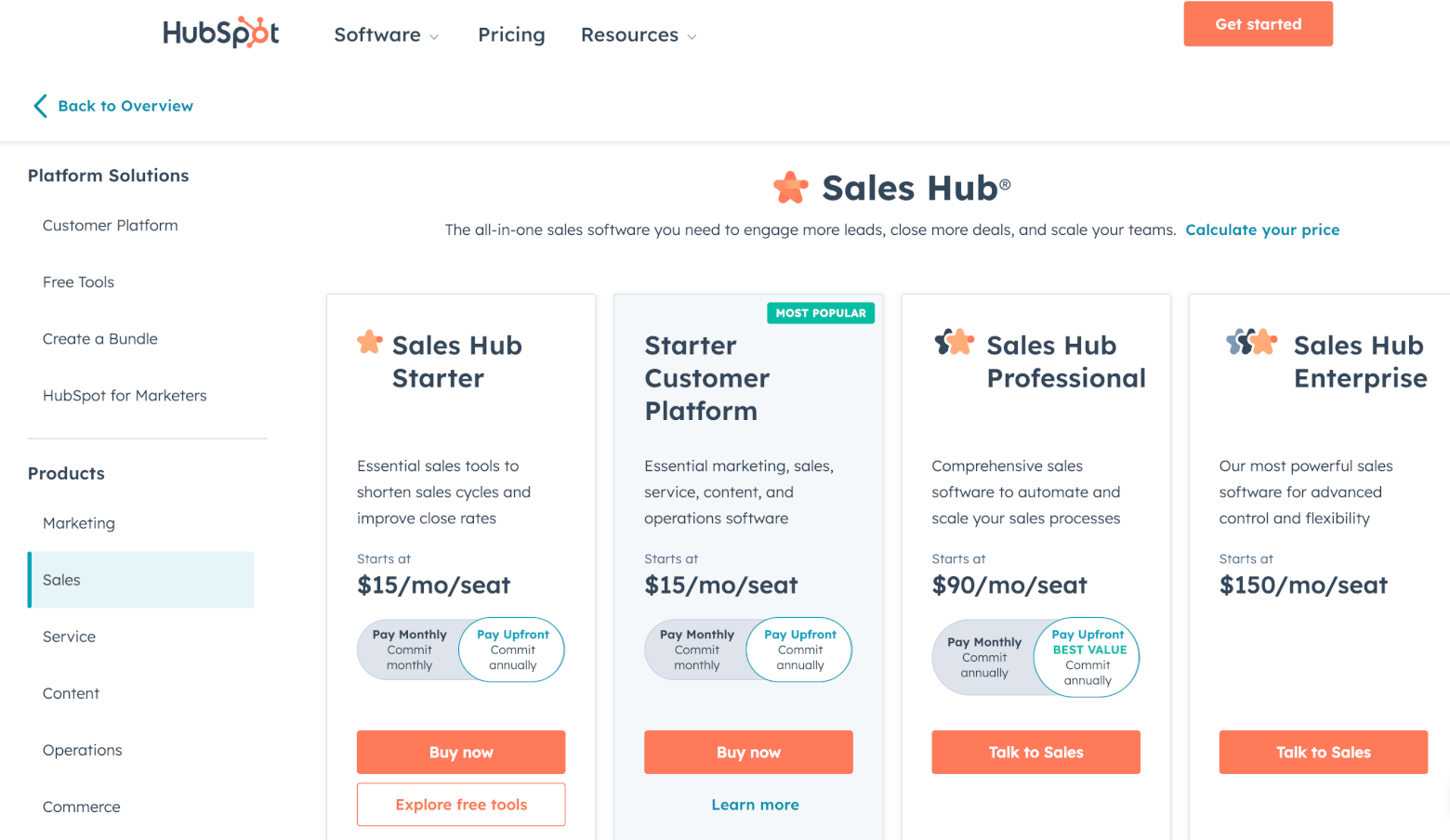
- HubSpot - a tiered model
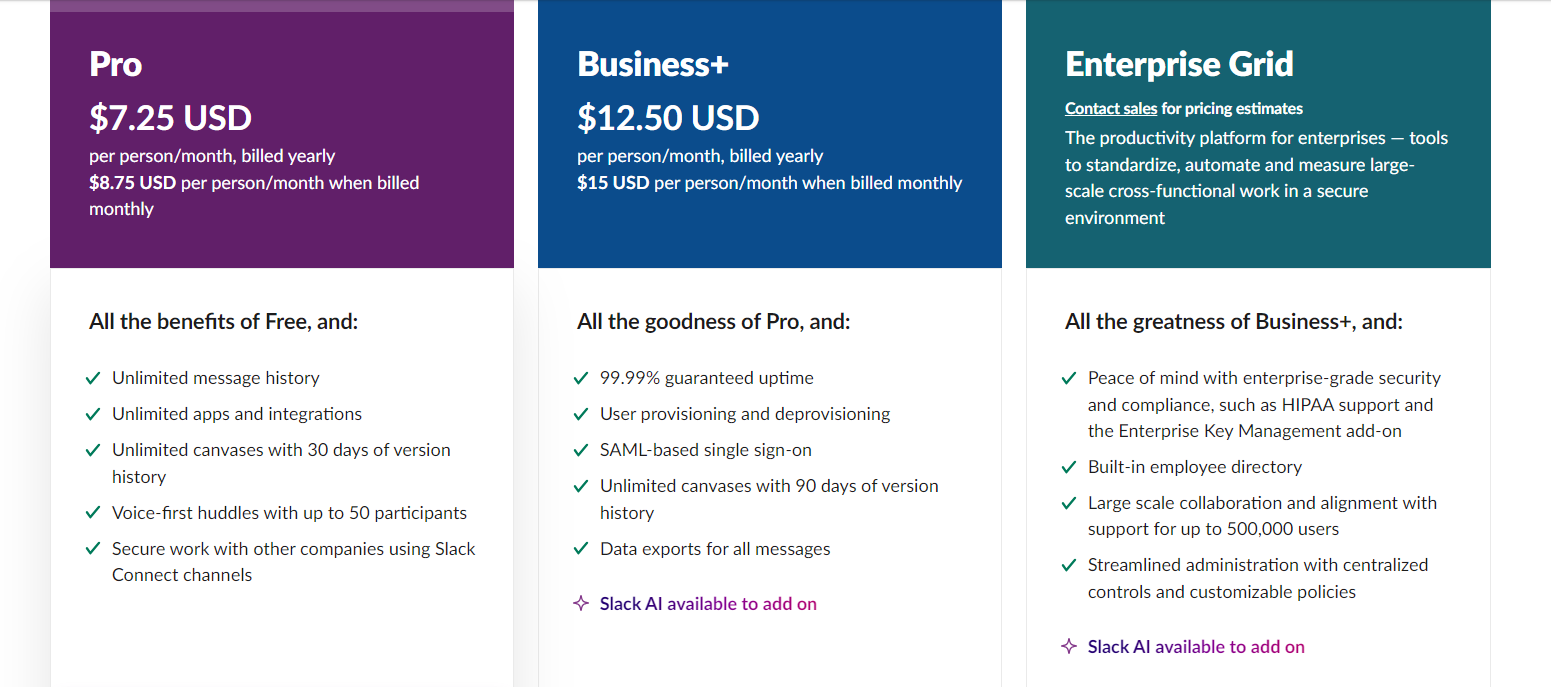
- Slack: per-active-user, so companies aren’t billed for dormant seats
- and Zapier (a hybrid of plan plus task volume).
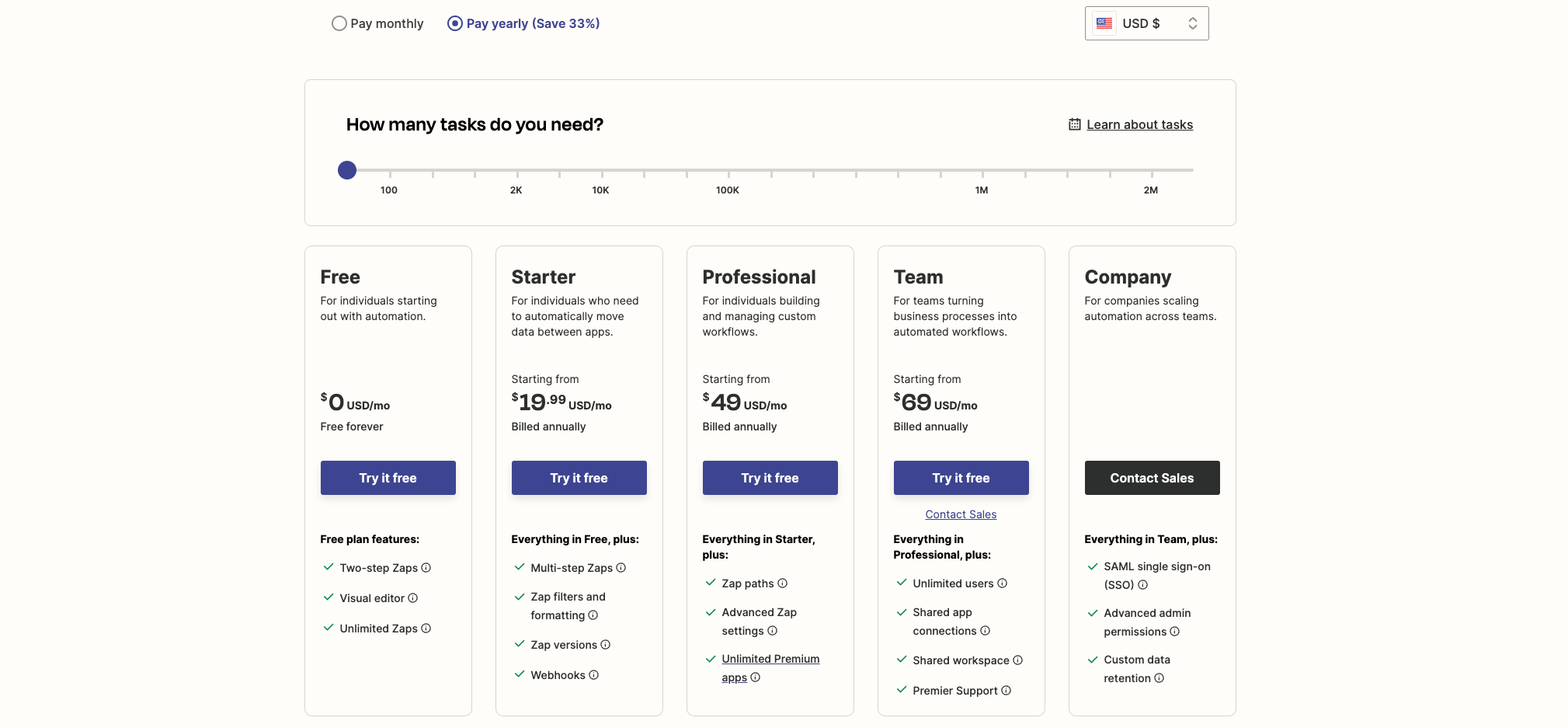
A practical technical note: configuring robust entitlement management is essential for tiered plans so that feature access and usage limits enforce automatically as customers move between packages.
Enterprise Models and Custom Contracts
Enterprise SaaS pricing models lean toward custom contracts priced by quote, with no public numbers on the pricing page. A common structure is the three-part tariff:
- a platform fee,
- an included usage allowance,
- and overage charges beyond it, which behavioral economics research shows customers perceive as fair and predictable.
Performance-based pricing is rarer but increasingly relevant for AI agents. Enterprise deals typically involve annual pre-payment, negotiation, SLAs, and integration with the customer’s ERP. Segment and AWS Reserved Instances are well-known examples. Technically, enterprise pricing demands accurate consumption auditing, multi-currency support, and compliance with GDPR and SOC 2 — non-negotiables for large buyers signing long-term agreements.
Hybrid and Two-Part Tariffs for B2B
A two-part tariff combines a fixed base fee for platform access with usage-based overage once a customer exceeds an included allowance. Enterprises love hybrids because they get the predictability of a committed baseline alongside the fairness of paying more only when they consume more.
This structure smooths revenue for the vendor while protecting the customer from runaway bills under normal use. Twilio (messaging volume on top of platform access) and MongoDB (cluster commitments plus consumption) are classic examples of how hybrid models scale gracefully from growing startups to large enterprises.
 Services Account
SaaS Pricing Models for AI Innovations
Not New Models, but a New Economy
Here, AI doesn’t invent fundamentally new pricing models: usage-based, tiered, and hybrid structures have existed for decades. What AI changes is the underlying economy. Consumption is now tokenized, compute is measured in GPU-hours, and COGS are unstable because LLM providers can adjust their prices several times a year. On top of that, customers struggle to predict their bills when usage maps to opaque token counts.
The result is a familiar set of models stretched to fit volatile costs and unpredictable demand. In this section we look at how to adapt standard SaaS pricing models to the realities of AI-powered products without exposing yourself — or your customers — to unnecessary risk.
Five Key AI Variations of Standard Models
The table below maps common AI pricing approaches back to their underlying classic model.
Each variation manages a different tension. Per-token pricing passes volatile model costs straight through to the customer, which keeps your margins safe but can cause bill shock. Per-agent pricing reframes the buyer’s mental model — you’re selling a digital worker, not seats. Feature add-ons let you monetize AI without rebuilding your entire pricing structure. Hybrids cap downside risk for both sides, and outcome-based pricing aligns most tightly with customer value while requiring airtight measurement.
If your product targets enterprise buyers, always add a hybrid structure — a fixed fee plus overage — to prevent the bill shock that derails renewals and erodes trust.
If you sell to developers who are comfortable reading dashboards and metering their own consumption, a clean per-token model can work perfectly well. Match the predictability of your pricing to the financial sophistication of your buyer.
Psychological Tactics to Boost Conversion
How you present prices matters almost as much as the numbers themselves. A few well-tested psychological tactics can meaningfully lift conversion on your pricing page:
- Anchoring. Place a higher-priced plan beside your target plan so the one you want customers to choose looks like a reasonable middle ground.
- Decoy pricing. Add a deliberately less attractive option that makes your preferred tier the obvious value choice.
- Charm pricing. Ending prices in 9 (e.g., $49 instead of $50) still nudges perception of affordability, even among B2B buyers.
- Highlight a “most popular” plan. Social proof reduces decision paralysis and steers buyers toward your best-margin tier.
- Annual discount framing. Show the per-month equivalent of an annual plan to make commitment feel cheaper while improving your cash flow.
- Reduce choice overload. Three or four tiers convert better than seven; too many options stall the decision entirely.
Use these tactics to clarify value, not to deceive — trust is the foundation of recurring revenue.
How to Choose the Right Pricing Model for Your SaaS Business
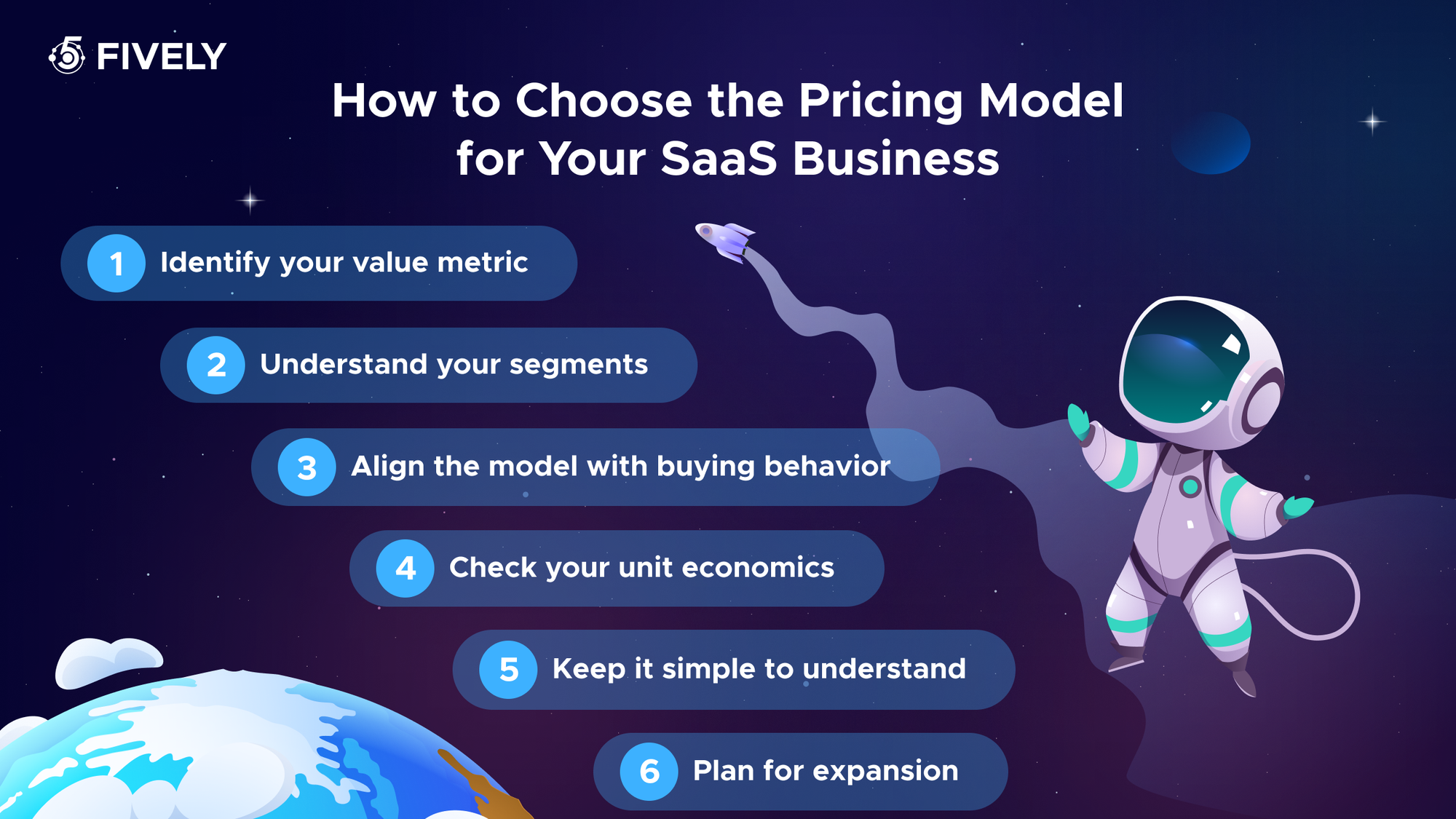
Choosing the right pricing isn’t about copying a competitor—it’s about matching structure to how your product creates value. When deciding how to price a SaaS product, work through these steps:
- Identify your value metric. Find the one variable that scales with the value customers get—seats, API calls, contacts, or transactions—and build pricing around it.
- Understand your segments. SaaS pricing for startups selling to SMBs differs sharply from enterprise deals; map willingness to pay across each buyer persona.
- Align the model with buying behavior. Self-service products favor flat-rate pricing or freemium; sales-led enterprise products favor custom contracts and hybrids.
- Check your unit economics. Make sure any model covers COGS and leaves room for healthy profit, especially with volatile AI costs.
- Keep it simple to understand. If a prospect can’t predict their bill, they’ll hesitate to buy. Clarity beats cleverness.
- Plan for expansion. The best pricing model for your SaaS grows revenue as customers succeed, through seats, usage, or upgrades.
Revisit this analysis as your product and market evolve; the right pricing model today may not be the right one next year. Selecting and optimizing your SaaS pricing is an iterative process, not a one-time choice.
Implementing Your SaaS Pricing Model
A great pricing strategy fails without the billing infrastructure to support it. Implementation is where economics meets engineering.
Components of a Billing System
A complete SaaS billing stack has five layers:
- a catalog (your plans, prices, and add-ons),
- metering (capturing usage events),
- rating (turning raw events into billable amounts),
- invoicing (generating statements and applying credits),
- and a payment gateway (collecting funds).
Each layer must stay in sync, or customers receive incorrect bills—a fast way to lose trust.
Off-the-Shelf Platforms vs. Custom Development
Platforms like Stripe Billing, Chargebee, and Paddle handle subscriptions, taxes, and dunning out of the box—ideal for most SaaS companies and a fast path to launch. Build custom only when your usage-based model is highly specialized, your volume is enormous, or you need pricing logic the platforms can’t express. The trade-off is clear: speed and reliability versus flexibility and maintenance cost.
Entitlement Management
Entitlement management is the system that programmatically controls which features and limits each customer can access based on their plan. Centralizing it lets you enable self-service activations, enforce tier boundaries automatically, and surface upsell signals when customers hit their limits—turning pricing rules into clean, enforceable code.
Example Architecture for a Usage-Based Model
A robust event-driven flow looks like this: an API Gateway receives requests, publishes usage events to Kafka, a Metering Service aggregates them, and a Billing Service rates and invoices the totals. This decoupled pipeline scales to millions of events and keeps billing accurate even under heavy load.
Security and Compliance for Pricing
Anything touching payment and usage data must respect PCI DSS for card handling and GDPR for personal data. Tokenize card details, audit usage logs, and restrict access to billing systems—compliance is a prerequisite for selling up-market.
Metrics to Track Pricing Performance
You can’t optimize what you don’t measure. Use analytics to monitor these core metrics:
- MRR/ARR — sum of all recurring revenue per month/year. Should trend steadily upward.
- ARPU — total revenue ÷ number of customers. Rising ARPU signals successful upsell and pricing power.
- Customer Lifetime Value (LTV) — ARPU × average customer lifespan. Should be at least 3× your CAC.
- CAC payback — CAC ÷ (ARPU × gross margin). Aim to recover acquisition cost within 12 months.
- Gross churn rate — revenue lost ÷ starting revenue. Lower is better; under 5% monthly for SMB, far lower for enterprise.
- Net Revenue Retention (NRR) — (starting revenue + expansion − churn) ÷ starting revenue. Above 100% means you grow even without new customers.
Tracking these together reveals whether your pricing changes actually improve the business or merely shuffle revenue around—and where to focus your next round of optimization.
 Services Account
How to Change Your Pricing Model Without Losing Customers
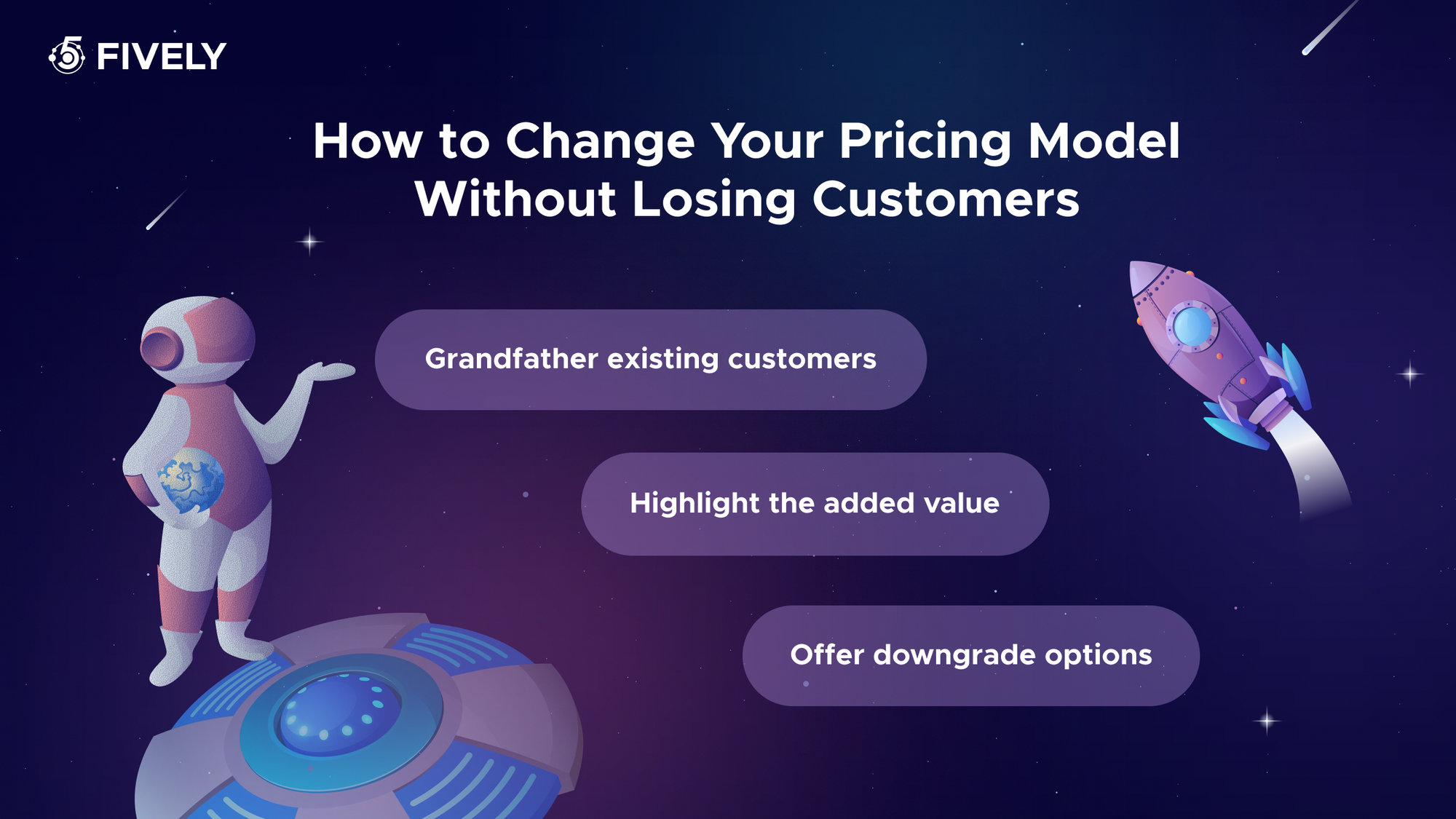
To change your pricing model without losing customers, clearly communicate the added value and give people choices that ease the transition. Grandfather existing clients into current rates, introduce new features that justify the shift, and provide ample notice before phasing in the new model.
Key strategies for a smooth transition:
- Grandfather existing customers. Let current clients keep their existing pricing for a set grace period (3 to 6 months), or apply new prices only to new customers. This protects loyalty and prevents a wave of cancellations.
- Highlight the added value. Pair every price update with tangible new benefits, expanded features, or better service so customers feel they’re getting more—not just paying more.
- Offer downgrade options. If the new model raises overall costs, provide a lighter or stripped-down tier. Giving customers control over their bill is far better than forcing a binary stay-or-cancel decision.
Roll out pricing changes gradually, communicate early and often, and lead with value at every step.
Conclusion
There is no single best pricing model — only the one that fits your product, your customers, and your stage of growth. The most successful SaaS companies treat pricing as a living system: they anchor it to a clear value metric, choose a model that scales with customer success, support it with solid billing infrastructure, and revisit it as the market shifts. Whether you’re a startup running penetration pricing to win share or an enterprise vendor negotiating two-part tariffs, the principles in this guide to SaaS pricing models and strategies give you a framework to price with confidence and grow sustainably.
 Services Account
Need Help With A Project?
Drop us a line, let’s arrange a discussion
Frequently Asked Questions
SaaS pricing is how a software-as-a-service company structures and charges for access to its product, typically as a recurring subscription rather than a one-time license. It combines a pricing strategy (how prices are set—cost-plus, competitor-based, or value-based) with a pricing model (the structure customers interact with, such as tiered, per-user pricing, or usage-based) to generate predictable, recurring revenue.
The most popular pricing models are flat-rate, tiered, per-user, usage-based, feature-based, freemium, and hybrid (subscription plus usage). Tiered and per-user models dominate B2B SaaS because they’re easy to understand and scale predictably, while usage-based and hybrid models are growing fast—especially for infrastructure and AI products where consumption varies widely.
Most SaaS companies should review pricing at least once a year, and more frequently if you’re early-stage, launching major features, or operating in a volatile cost environment like AI. Regular reviews let you respond to competitor pricing, rising value, and shifting customer behavior—just be sure to communicate any pricing changes thoughtfully and protect existing customers during the transition.


