
Generative AI Development Services

• 14 min
I'm a content specialist at Fively keen on writing fresh articles that can help out business and tech specialists. I love to conduct research, hold interviews, and spotlight sophisticated tech issues.
Fively provides generative AI development services to transform promising AI concepts into secure and production-ready systems that deliver measurable business value at scale.
We design, build, and ship production-grade generative AI development services, from RAG pipelines to agentic systems engineered for enterprise security, compliance, and measurable business value. In this article, read how we do it: it takes architecture, data discipline, and a delivery team that has shipped AI software into regulated environments before.
Our Generative AI Development Services
Generative AI Consulting and Strategy
Before a single model is selected, we map your operations, data readiness, and existing automation to find where using generative artificial intelligence will generate the strongest, most defensible return. The deliverable is a prioritized roadmap: which use cases to tackle first, which AI model and architecture fit your constraints, how to sequence the rollout, and what success looks like in numbers.
Ideal for: enterprises with multiple candidate use cases that need an evidence-based plan before committing budget.
Custom Generative AI Development
Every system we build is engineered around your business logic rather than forced into a generic template. We design the reasoning layer, connect it to your proprietary data, and construct the generation flow that keeps outputs accurate, on-brand, and within defined boundaries. From document synthesis to content generation pipelines, the custom generative AI we ship reflects your workflows, not someone else’s.
Ideal for: organizations whose requirements around accuracy, domain language, or data privacy rule out off-the-shelf tools.
RAG-Powered Artificial Intelligence Solutions
Retrieval-augmented generation connects a large language model to your internal knowledge (policies, product databases, support histories, research files), so responses stay grounded in your actual data instead of relying on pre-training alone. We build the retrieval pipeline, manage vector indexing, and implement context strategies that minimize hallucination and keep answers current. We also handle the parts teams often underestimate: permission-aware retrieval so each user only sees data they’re authorized to access, and evaluation harnesses that measure answer accuracy against a domain test set rather than relying on impressions.
Ideal for: knowledge-heavy use cases like internal assistants, self-service Q&A, and compliance research where factual accuracy is non-negotiable.
AI Agent Development
When a task requires more than a single response, we build AI agents that reason about goals, call tools and APIs, and execute multi-step workflows across systems. Unlike scripted bots, these agents plan, act, and adapt through feedback loops — handling everything from claims intake to procurement coordination. Most enterprise deployments now pair a generative core with agentic orchestration on top.
Ideal for: automating end-to-end processes that span several systems and currently demand constant human handoffs.
AI Chatbot and Conversational AI
We develop conversational interfaces that go well beyond the experience of a basic ChatGPT wrapper. Grounded in your data through RAG and tuned to your domain, these chatbots handle natural-language interaction across text and voice, route complex cases to humans, and maintain consistent, permission-aware responses. The result is support and engagement automation that customers actually trust.
Ideal for: customer support, internal helpdesks, and onboarding flows that need accurate, brand-aligned answers at scale.
Generative AI Integration
We don’t just bolt AI onto the side of your stack — we prepare and structure data for fine-tuning, select the right models, and ensure smooth integration through secure APIs and cloud platforms, minimizing disruption while optimizing performance and scalability. Our generative AI integration connects models to CRMs, ERPs, knowledge repositories, and legacy software so AI becomes a strategic enabler rather than an isolated tool.
Ideal for: companies that want intelligence layered into the products and platforms their teams already use every day.
Model Fine-Tuning and Optimization
Where standard models fall short on domain language or task accuracy, we scope fine-tuning, instruction tuning, or hybrid approaches that close the gap. Through careful deep learning workflows and benchmark-driven evaluation, we raise precision without inflating cost, then keep the model sharp with continuous optimization as your data evolves.
Ideal for: specialized domains — legal, clinical, financial — where generic model accuracy isn’t enough.
GenAI-Powered Data Analytics
Generative artificial intelligence changes how teams interact with their own data. We build conversational analytics layers that let non-technical users query dashboards in plain language, auto-generate narrative summaries of complex datasets, and combine generation with predictive analytics and machine learning so insight comes with context, not just numbers. Instead of waiting on an analyst for every question, decision-makers get answers — and the reasoning behind them — on demand.
Ideal for: data-rich organizations that want faster, self-serve decision-making across non-technical teams.
Why Choose Fively Generative AI Development Company?
Choosing a generative AI development company is mostly a question of trust: can this team take a software development idea to production without creating security, compliance, or maintenance debt you’ll pay for later? Here is why enterprises and funded startups partner with us.
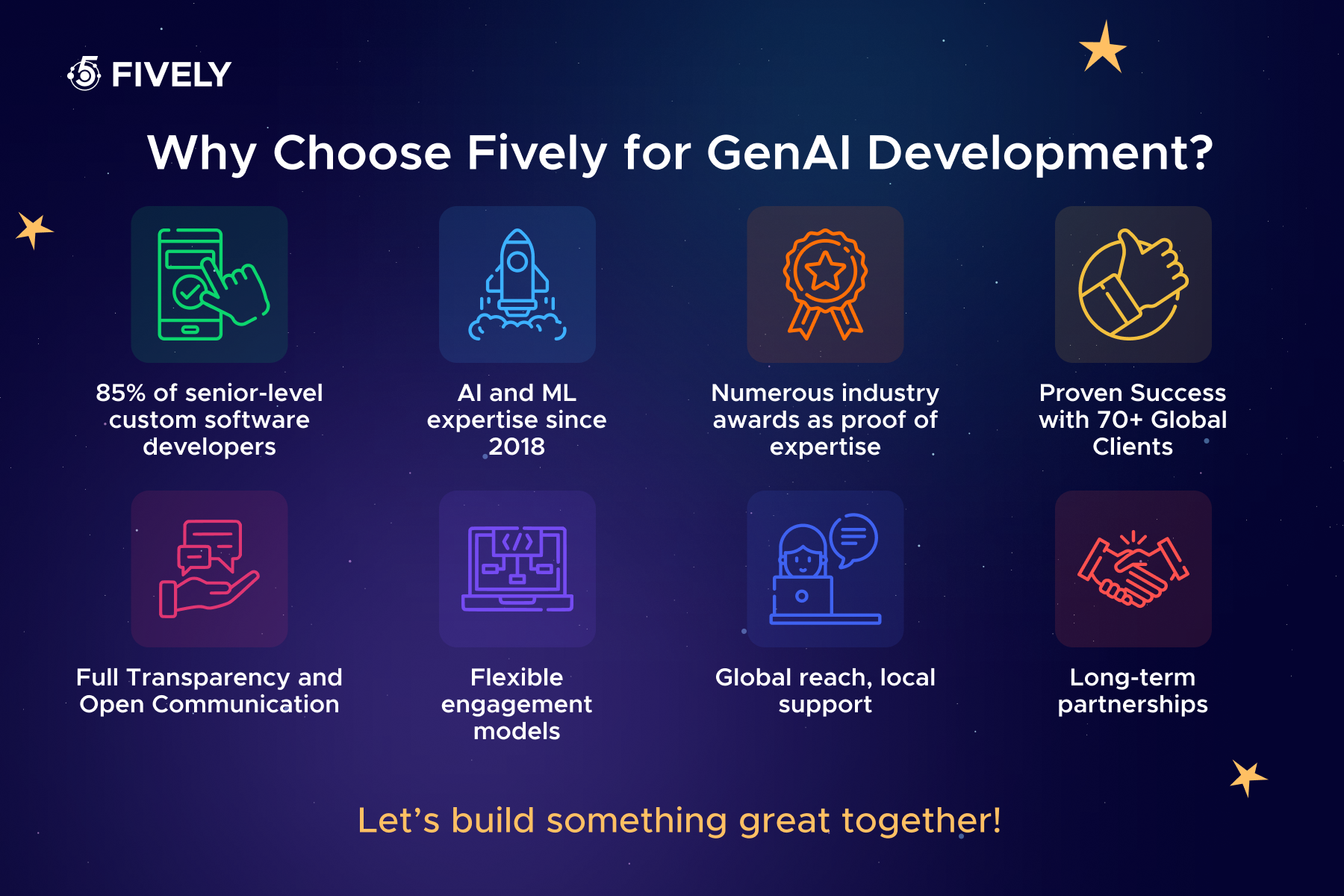
- A real AI track record since 2018. We were shipping production machine learning systems years before large language models entered mainstream conversation. That depth matters when the goal isn’t a demo but a system that holds up under real workloads.
- Senior-led engineering. Around 85% of our team works at a senior level, because complex generative AI systems demand experienced builders — people who know what to trust from a model and what to rewrite.
- In-house specialists, not generalists stretched thin. Our teams include AI and ML engineers, data scientists, LLM and prompt-engineering specialists, solution architects, and DevOps engineers who understand both the technology and the industries we serve.
- Full-cycle ownership. Strategy, architecture, development, deployment, and ongoing support come from one accountable team with no handoff gaps — so accountability never falls between vendors.
- Regulated-industry experience. PCI-DSS, HIPAA, GDPR, and SOC 2 are understood at the architecture level, not treated as a post-launch patch. We’ve delivered software for FinTech, HealthTech, insurance, and cybersecurity clients where getting compliance wrong simply isn’t an option.
- Recognized delivery. Fively holds a 5.0 rating across 30 verified reviews on Clutch, alongside recognition as a Clutch Global Leader — external signals that back up what our clients tell us directly.
Underneath all of this is a simple operating principle: we’d rather tell you a use case isn’t ready than ship something that erodes trust. Not every problem needs a custom model, and not every chatbot qualifies as an AI agent. We help you pick the architecture that matches the real complexity of your use case — nothing over-engineered, nothing under-built — and we’re candid about trade-offs in cost, latency, and accuracy from the first conversation.
Our Commitment to Responsible and Ethical Generative AI
Deploying generative AI into production demands more than functional accuracy: outputs have to be explainable, data has to stay protected, and behavior has to remain inside defined limits — especially in regulated sectors. We’ve applied these principles on sensitive, high-stakes systems, including a patient management platform that makes well-considered decisions based on AI algorithms within a HIPAA-aware architecture, and an identity and access management automation system trusted enough to be recommended by the association of Danish Auditors.
AI Governance and Compliance
Our approach to governance ensures your generative AI systems stay ethical, transparent, secure, and aligned with global standards across their entire lifecycle. Rather than auditing behavior after the fact, we build the controls in from the first design decision.
- Bias and fairness audits that test for skewed outcomes and keep AI decisions equitable across user groups.
- Privacy-first design aligned with GDPR, HIPAA, CCPA, and the EU AI Act, with PII redaction and data minimization enforced at every touchpoint.
- Transparent governance frameworks that assign accountability across the AI lifecycle, so every model has a clear owner and review cadence.
- Full auditability and traceability, where each output, tool call, and reasoning step is logged with context to support regulatory review.
- Continuous monitoring that adapts to evolving business needs and shifting legal requirements rather than freezing at launch.
For high-risk app development (credit scoring, clinical support, critical workflows), we add governance layers including risk classification, documentation of training-data provenance, and audit-ready logging of decision pathways.
Data privacy is handled at the architecture level rather than bolted on afterward. For sensitive workloads, we can deploy models inside your own infrastructure to eliminate data leakage entirely; where external APIs are used, we enforce encryption in transit and at rest, role-based access control, and strict data minimization. The goal is straightforward: the system should never have access to more data than the task genuinely requires.
Human-in-the-Loop for Enterprise-Ready AI
Automation is powerful, but judgment still matters. We combine AI efficiency with human review to deliver generative AI solutions that are accurate, ethical, and aligned with how your business actually operates.
- Align AI output to business needs. Human validators refine generated text, summaries, and recommendations to match brand voice, domain standards, and compliance rules.
- Handle complex and edge cases. Experts review atypical prompts and sensitive scenarios so the system behaves reliably even in high-risk contexts.
- Improve models with human feedback. Reviewed outputs become fresh training data, helping models adapt quickly to market and customer changes.
- Keep AI transparent and audit-ready. Human checkpoints at critical steps create the traceability and documentation that governance and stakeholder trust depend on.
For decisions that carry real consequence, outputs route to human reviewers automatically whenever model confidence drops below a defined threshold — a balance of speed and accountability that makes AI genuinely enterprise-ready.
 Services Account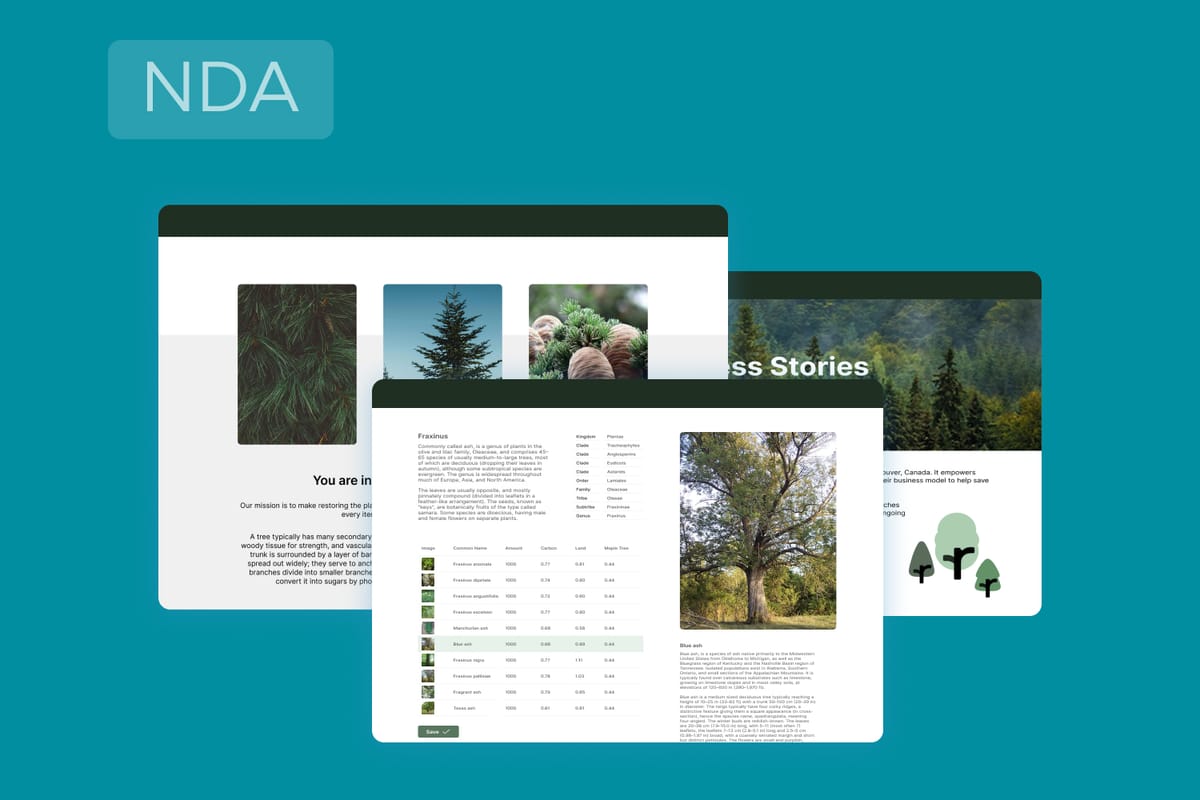
Our Generative AI Development Process
We follow a structured development process designed to reduce uncertainty and move from idea to production on a predictable timeline. Each phase produces concrete deliverables, so you always know what’s been validated before the next stage of investment.
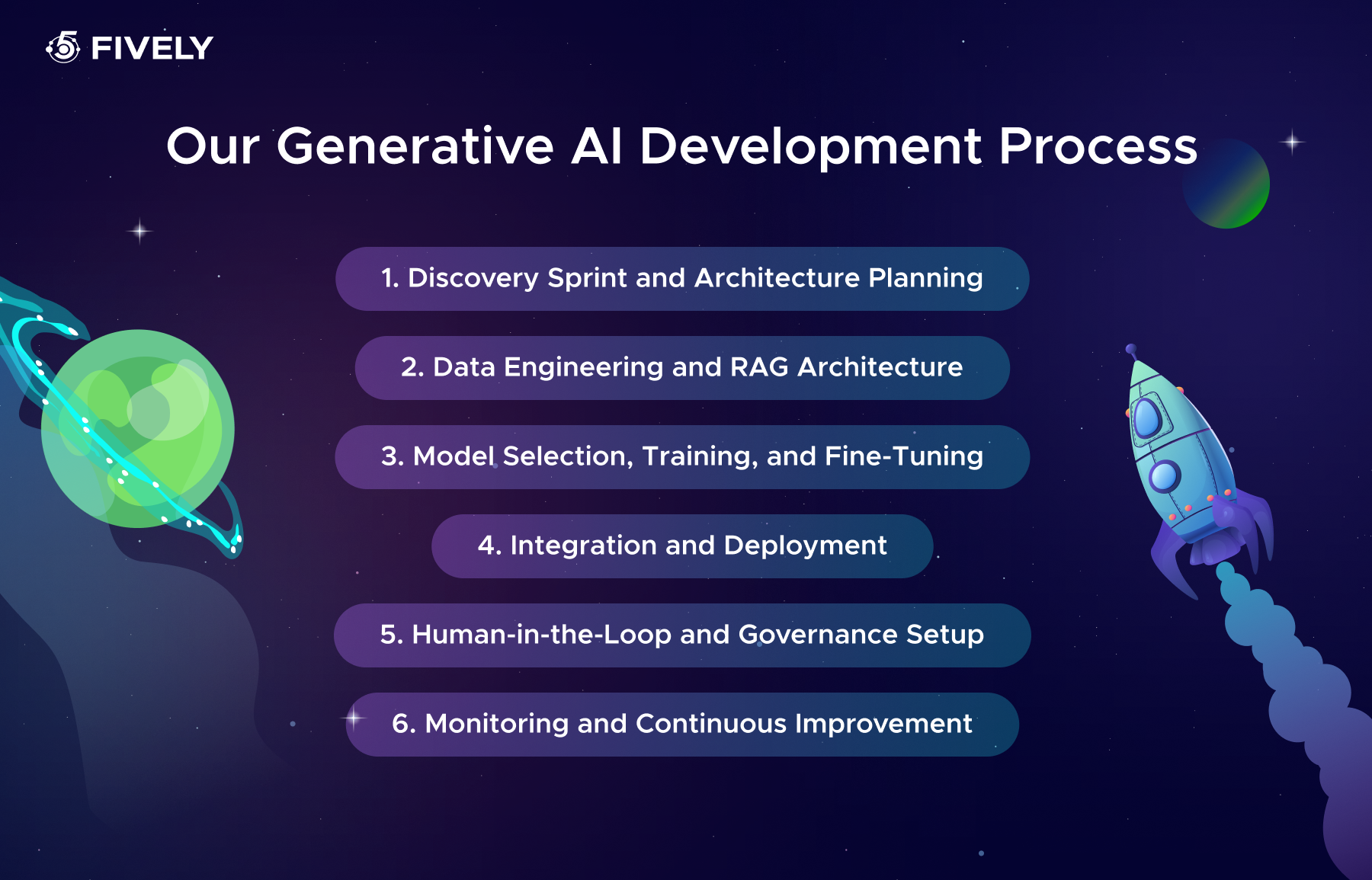
1. Discovery Sprint and Architecture Planning
Every initiative begins with precise problem framing. We assess your data readiness, identify high-impact use cases, and determine the optimal architecture — LLM, RAG, agentic, or hybrid. This phase produces a technically validated roadmap with success metrics and a risk and compliance evaluation before development begins.
2. Data Engineering and RAG Architecture
High-performing systems depend on well-structured data. We prepare domain knowledge corpora, build embedding pipelines, and design the retrieval architecture that grounds outputs in your enterprise context — the foundation that separates a reliable generative AI solution from an impressive-looking one.
3. Model Selection, Training, and Fine-Tuning
Based on your needs for accuracy, latency, privacy, and budget, we select the right combination of models and frameworks. Where standard models fall short, we run fine-tuning and instruction-tuning workflows, then validate against domain-specific benchmarks to confirm the system meets your accuracy bar.
4. Integration and Deployment
We connect the system to your operational stack — CRMs, ERPs, knowledge bases, and custom platforms — through secure APIs and orchestration layers. Models deploy to your environment of choice (cloud, private cloud, or on-premises) with monitoring dashboards, alerting, and rollback mechanisms active from day one.
5. Human-in-the-Loop and Governance Setup
Before scale-up, we stand up the review workflows, confidence thresholds, bias-monitoring, and compliance logging that keep the system trustworthy in production. Governance isn’t a final step — it’s wired into the operating model.
6. Monitoring and Continuous Improvement
After launch, we track performance KPIs, gather user feedback, and run periodic evaluations. Prompts, retrieval configurations, and model parameters are tuned against real usage so the system keeps pace with evolving data, regulations, and business goals.
Technology Stack We Leverage
We choose technologies based on what each project requires — not to pad a capabilities list. Here is the core stack our engineers work with when building generative AI solutions.
This stack lets us support both API-based deployments and fully private setups using open-source models on your own infrastructure — important for healthcare, finance, and legal clients with strict data-residency requirements.
Industries We Serve with Generative AI Services
We build generative AI around specific industry problems rather than shipping generic tools that take months of configuration to become useful. Across every sector, the through-line is the same: ground the model in real data, embed it in real workflows, and keep a human in the loop where it counts.
Financial Services and FinTech
In finance, generative AI accelerates the knowledge work that slows teams down. Our solutions generate automated financial reports and executive summaries, condense regulatory updates into actionable compliance briefs, draft investment research from structured market data, and power conversational analytics over dashboards — all with the audit-trail depth financial compliance demands. Fively has also delivered anti-fraud solutions for telecom companies at enterprise scale, applying the same rigor to risk and security.
Healthcare and HealthTech
For healthcare providers, we build documentation assistants that structure clinical notes, knowledge assistants that surface guidance for staff, and patient-facing tools that route complex cases to clinicians — all within HIPAA-aware architectures. Generative AI also supports faster medical data analysis and treatment-personalization workflows that help practitioners act with better context, never replacing clinical judgment but accelerating it.
Insurance
Insurance runs on documents, and that’s where using generative AI pays off fastest. We build claims-summarization and intake systems, underwriting risk-assessment narratives, policy documentation aligned with regulations, and fraud-pattern analysis summaries. Our automation experience here is proven: the insurance workflow automation solution we delivered compresses the path from buying a policy to filing a claim into a five-minute procedure.
Retail and eCommerce
For retail, generative AI scales personalization and content. We build systems that generate product descriptions at scale, deliver AI-driven recommendations and cross-sell messaging, summarize customer reviews into actionable insight, and power conversational shopping assistants that lift conversion without expanding headcount.
Logistics and Supply Chain
In logistics, our solutions summarize shipment status and exception reports in real time, generate demand-forecasting narratives, draft vendor and SLA communications, and surface risk alerts from disruption signals — turning scattered operational data into decisions teams can act on quickly.
Manufacturing
On the factory floor, generative AI services turn raw machine and process data into usable knowledge. We build systems that generate maintenance summaries from log data, draft standard-operating-procedure documentation from operational inputs, summarize quality-inspection findings into compliance-ready formats, and power knowledge assistants for plant teams. The payoff is faster, better-documented decisions without pulling experienced engineers away from the work only they can do.
Cybersecurity
Security teams drown in alerts, and generative AI helps them surface signal from noise. We build assistants that triage and classify threats, summarize incidents into clear remediation briefs, and generate documentation for audits and post-incident review. Drawing on Fively’s track record in cybersecurity and identity management, every such system is designed to operate inside strict access controls and leave a complete audit trail.
 Services Account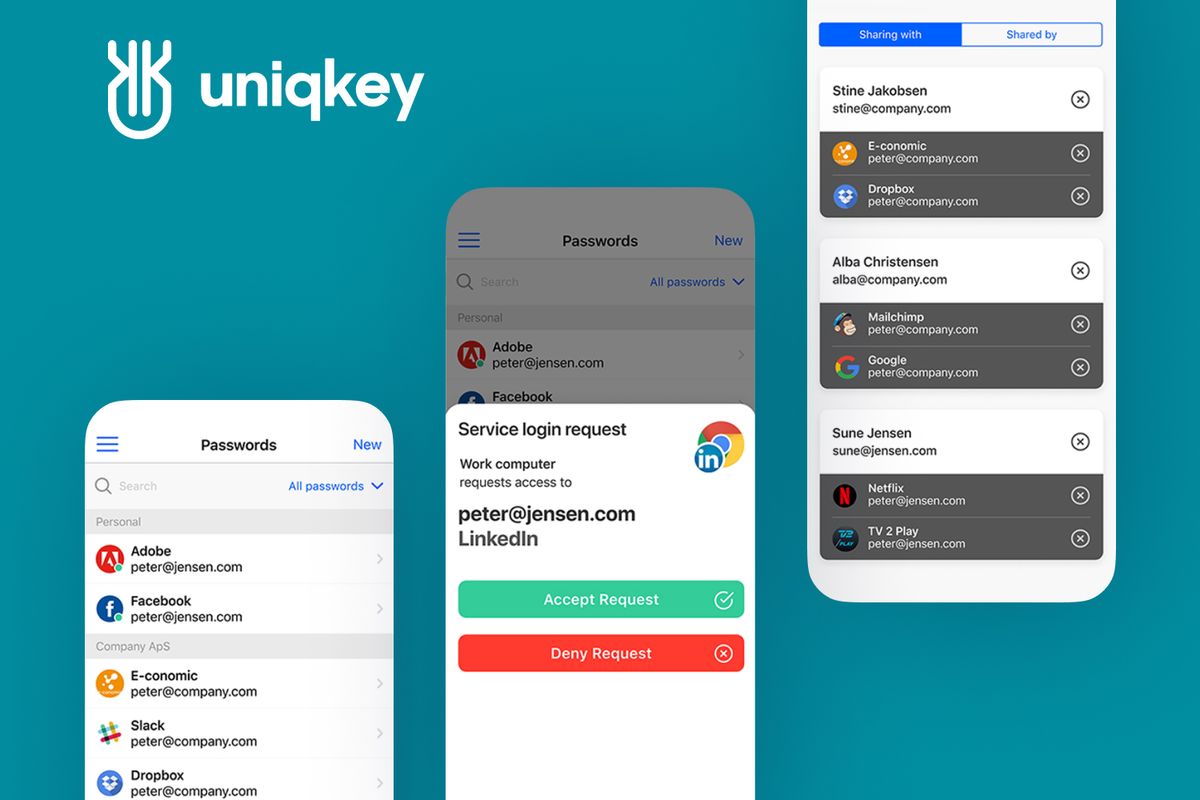
Reviews
External validation matters more than self-description. Fively holds a 5.0 rating across 30 verified reviews on Clutch. A few that speak to how we work on AI and other trust-dependent projects:
“We are most impressed with the fact that we have managed to hire a diverse team of specialists from one software company. There work not only people with knowledge of web technologies, but also experienced AI/ML engineers familiar with modern frameworks.” — CEO, AI Analytics Company
“We collaborate with top-notch web developers who tackle challenges fearlessly. It’s worth every penny, no doubt.” — CTO, Legal Tech Solutions Company (Definely)
“The most impressive thing about them is how they handle complex refactoring without disrupting the overall system. They adapt modern technologies like NestJS, MongoDB, and Kafka alongside the existing stack.” — Jorge Martins, CTO, DextraData GmbH
Engagement Models
Different projects call for different levels of involvement, so we offer flexible engagement models that match your goals, in-house capacity, and how much control you want to keep.
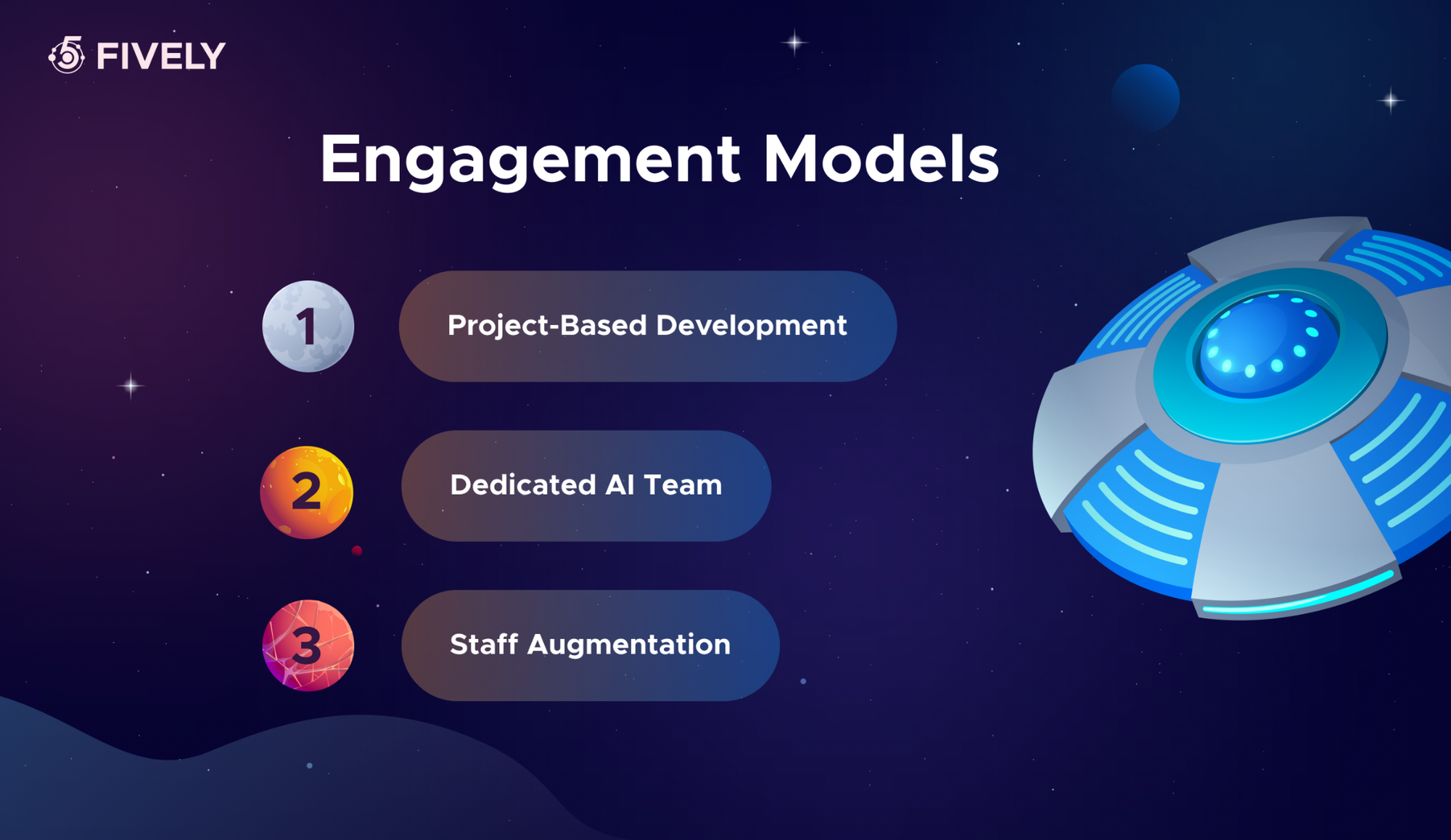
Project-Based Development
We take full ownership of a defined scope — planning, building, and delivering an end-to-end generative AI solution against agreed milestones. Best for organizations with a clear use case that want a managed outcome without running the project day to day.
Dedicated AI Team
We assemble a cross-functional team — AI engineers, data scientists, and a project manager — that works as a managed extension of your organization on ongoing development and optimization. Best for long-term initiatives and evolving roadmaps that need consistent velocity.
Staff Augmentation
We embed specific AI specialists into your existing team to close skill gaps fast, with your side directing the work. Best when you have in-house leadership and need senior generative AI expertise on demand, without long-term hiring commitments.
Let’s Build Your Generative AI Solution
Generative AI delivers real value when it stops being an experiment and starts solving operational problems across your business. Whether you’re validating a first use case or scaling an existing system, our team is ready to guide you from strategy and architecture through deployment and continuous improvement — with security, compliance, and measurable impact built in from day one.
Have an idea worth shipping? Let’s talk!
 Services Account
Need Help With A Project?
Drop us a line, let’s arrange a discussion
Frequently Asked Questions
Cost scales with scope. A focused proof-of-concept or MVP — a RAG chatbot or a single content-generation tool — typically runs in the low-to-mid five figures. A production-grade feature integrated into an existing product generally falls between roughly $70,000 and $300,000, while full enterprise platforms are scoped individually. We start every engagement with a use-case assessment that maps investment to expected ROI, so you see the business case before committing to development.
A pilot or proof-of-concept can often ship in four to six weeks. A production-ready feature that integrates with your systems, meets compliance requirements, and is tested for quality usually takes two to four months. Enterprise-scale systems with custom training and governance layers can run longer, depending on data readiness and regulatory scope. Starting with a clear, focused use case is the fastest route to value.
Yes. Most of our solutions are designed to layer onto existing products through secure APIs, plugins, or microservices. We build integration layers and purpose-built connectors that let models communicate with CRMs, ERPs, knowledge bases, and legacy platforms — preserving your infrastructure while giving the system controlled, auditable access to the data and actions it needs. We also map out data flows and access permissions up front, so the integration stays secure and your teams can adopt it smoothly without disruptive changes to how they already work.
RAG retrieves relevant information from your knowledge bases at query time, grounding answers in your current, proprietary data and reducing hallucination — ideal when accuracy and freshness matter and your information changes often. Fine-tuning adjusts the model itself to master domain language, tone, or specialized tasks — ideal when you need consistent behavior in a narrow domain. Many enterprise systems use both: RAG for factual grounding, fine-tuning for domain fluency. During discovery we recommend the right mix for your use case rather than defaulting to one.
Yes. Launch is the starting point, not the finish line. We monitor performance, refine prompts and retrieval configurations, retrain models as accuracy drifts, and update governance controls as regulations evolve. Whether through a dedicated team or a defined support agreement, we keep your generative AI solution accurate, secure, and aligned with your business as it grows.


